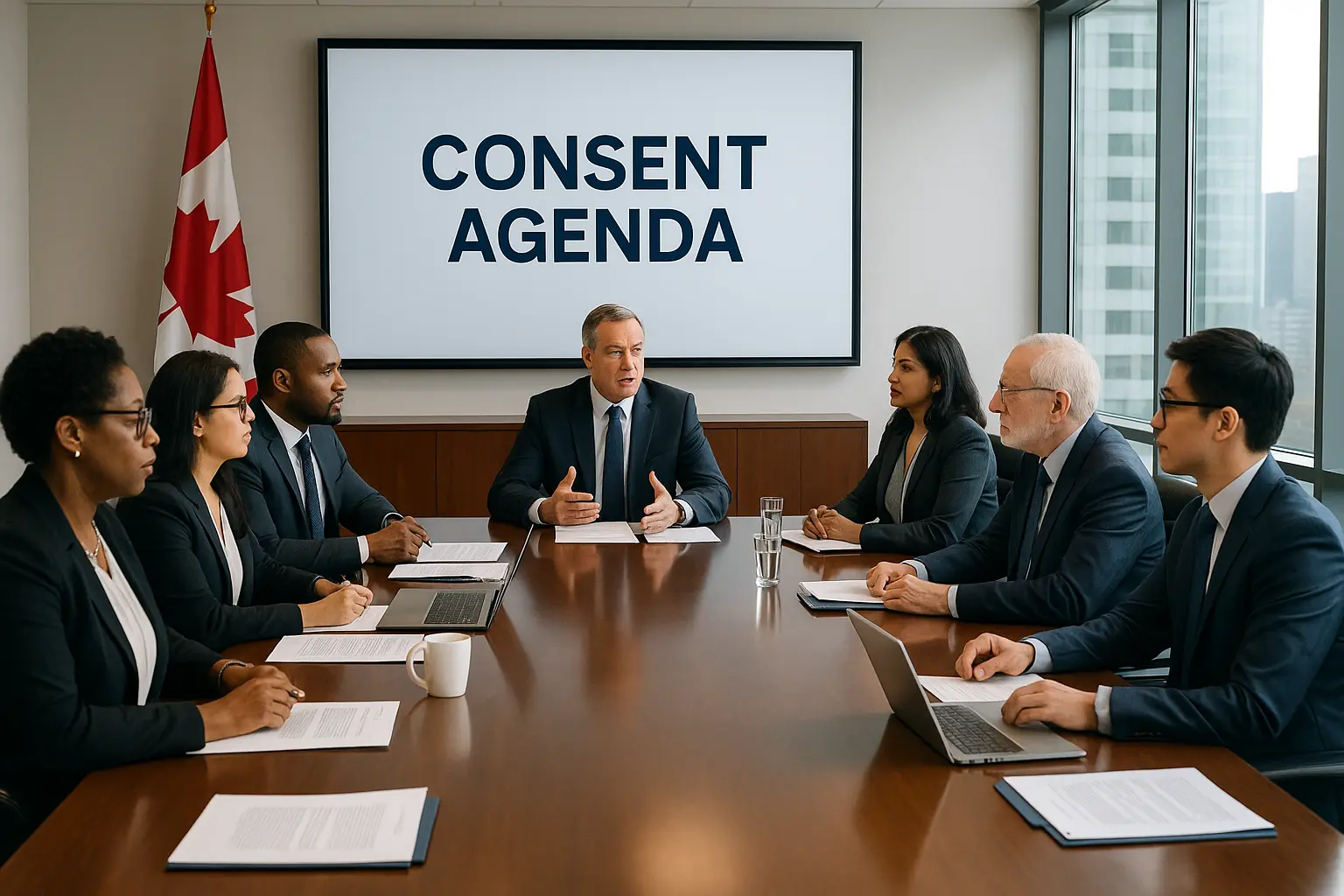
What Is a Consent Agenda for a Board Meeting in Canada?
Board meetings in Canada often run long when directors discuss routine matters that don’t require debate.
A consent agenda groups routine, non-controversial items together so the board can approve them all with a single vote, saving valuable time for strategic discussions.
This practice has become popular among Canadian boards because it streamlines the approval process for items like meeting minutes, standard committee appointments, and recurring contract renewals.
We’ll explore how consent agendas work in the Canadian board context and what types of items belong on them.
Understanding the process for implementing and documenting these grouped approvals helps your board run more efficient meetings while maintaining good governance.
The key to success is knowing which items are appropriate for consent treatment and following procedures to ensure transparency and accountability.
We’ll also cover the benefits Canadian boards experience and common mistakes to avoid with this approach.
Defining a Consent Agenda in Canadian Board Meetings

A consent agenda groups routine, non-controversial items that require board approval into a single voting block.
This approach allows Canadian boards to focus meeting time on strategic discussions and efficiently handle administrative matters.
Purpose and Importance of a Consent Agenda
The consent agenda saves time and changes how we conduct board meetings across Canada.
By bundling routine items, we avoid lengthy discussions about matters that don’t require debate.
Key benefits include:
- Time efficiency: We can approve multiple items with one motion
- Enhanced focus: More time remains for strategic planning and governance
- Improved productivity: Meetings become shorter and more purposeful
- Better engagement: Board members stay focused on high-impact decisions
We typically include items like previous meeting minutes, routine committee appointments, and standard contract renewals.
These items require formal board approval but shouldn’t generate discussion.
The consent agenda works only when we distribute materials early.
Board members need time to review documents before the meeting.
Any member can request that an item be moved to the regular agenda for discussion.
Difference Between Consent Agenda and Regular Agenda
The consent agenda differs from our regular meeting agenda in structure and purpose.
We use the consent agenda only for action items that need board votes but expect no debate.
Consent agenda characteristics:
- Routine, non-controversial items only
- Single vote approves all items together
- Any member can pull items for discussion
- Requires advance document distribution
Regular agenda features:
- Discussion and debate expected
- Individual motions and votes
- Strategic and complex matters
- Real-time presentations allowed
We should never use the consent agenda to bypass proper oversight.
Items needing thoughtful consideration belong on the regular agenda.
The consent agenda handles administrative necessities, while the regular agenda addresses governance responsibilities.
Information-only reports don’t belong on either agenda type unless they require specific board action.
Consent Calendar: Alternate Terminology
Many Canadian organizations use “consent calendar” and “consent agenda” interchangeably.
Both terms describe the same meeting practice of grouping routine items for efficient approval.
The terminology varies by region and organization type.
Government boards often prefer “consent calendar,” while non-profit organizations typically use “consent agenda.”
Common variations we encounter:
- Consent agenda (most common)
- Consent calendar
- Consent items
- Routine agenda
No matter the name, the function stays the same.
We’re creating a streamlined process for handling necessary but uncontroversial business matters.
Consistency within our organization is essential.
Once we select terminology, we should use it in all board documentation and communications.
Types of Items Included in a Consent Agenda
Consent agendas contain routine business items that require board approval but need minimal discussion.
These items include administrative matters, standard reports, and procedural decisions that boards must formally approve.
Non-Controversial Items for Board Approval
Non-controversial items form the backbone of most consent agendas.
These are routine decisions that require formal board approval but generate little debate among members.
Staff and volunteer appointments are common consent agenda items.
When we hire new employees or appoint volunteers to standard positions, these decisions rarely require discussion.
Routine policy updates also belong on consent agendas.
Minor changes to contact information, standard procedures, or administrative details qualify as non-controversial items.
Grant applications and donations often appear on consent agendas.
When we receive expected funding or routine donations, these items need formal acknowledgment without debate.
The key test for any item is whether board members can reasonably approve it without discussion.
We should only include items that have been reviewed beforehand and pose no significant concerns.
Typical Committee Reports
Committee reports appear on consent agendas when they serve informational purposes and don’t require specific actions.
These reports keep the full board informed about ongoing work.
Monthly committee updates work well as consent items.
When committees report regular progress on established projects, these updates rarely need board discussion.
Committee recommendations may qualify for consent agendas if they follow established policies.
Routine hiring recommendations or standard procedure approvals often fit this category.
We must distinguish between informational reports and those requiring board action.
Only reports that need formal acknowledgment should appear on consent agendas, not general updates.
Committee chairs should indicate which reports require consent approval versus those shared for information only.
This helps us maintain proper board governance while saving meeting time.
Financial Reports and Documents
Financial documents commonly appear on consent agendas when they reflect routine financial activities.
These items require formal board approval but may not need discussion.
Monthly financial statements often qualify as consent items.
When our finances follow expected patterns and budgets remain on track, these reports need acknowledgment without detailed review during meetings.
Routine payments and expenditures frequently appear on consent agendas.
Regular operational expenses, vendor payments, and budgeted expenditures typically require formal approval without discussion.
Investment reports and banking documents may qualify when they show standard activity.
Routine investment updates or banking resolutions often need board approval through consent procedures.
We must review all financial items before meetings.
Board members should examine financial documents during their pre-meeting review period.
Meeting Minutes and Previous Decisions
Meeting minutes are the most common consent agenda items across Canadian boards.
These administrative documents require formal approval but rarely generate discussion.
Previous meeting minutes almost always belong on consent agendas.
Once board members review draft minutes and suggest corrections, final approval usually proceeds without debate.
Follow-up items from previous meetings may qualify for consent treatment.
When we complete previously assigned tasks or implement approved decisions, these updates often need formal acknowledgment only.
Routine correspondence and communications sometimes appear as consent items.
Standard letters, regulatory filings, or administrative communications may require board approval without discussion.
The board secretary prepares these items.
We rely on accurate documentation and clear presentation for proper approval of administrative matters through our consent process.
Consent Agenda Process and Approval
The consent agenda process requires careful preparation before meetings and follows clear steps during board meetings.
Board members must receive materials in advance, and any member can request to move items to the regular agenda for discussion.
Preparation Before the Meeting
We must distribute all consent agenda materials to board members before the meeting date.
This advance distribution allows proper review of routine items without taking up meeting time.
Key preparation steps include:
- Compiling routine, non-controversial items that require board approval
- Creating detailed documentation for each consent agenda item
- Sending materials at least one week before the board meeting
- Including clear summaries explaining why each item belongs on the consent agenda
The chairperson decides which items qualify for the consent agenda.
Only items requiring formal board votes should be included, never informational reports.
Board members should review all consent agenda materials before attending the meeting.
This preparation helps identify any items that might need discussion or clarification.
We recommend including a brief explanation with each item.
This helps board members understand the action being requested and confirms the item is routine.
Presenting the Consent Agenda at the Meeting
During board meetings, we present the consent agenda as a single package of items.
The chairperson begins by asking if any board members want to remove items for separate discussion.
The standard process follows these steps:
- Chairperson reads the consent agenda items aloud
- Members are asked if they want to pull any items
- Remaining items are approved with one motion
- All items pass together without individual votes
Once we remove any requested items, the remaining consent agenda items are approved together.
This saves significant time during board meetings.
The secretary records all approved items in the meeting minutes.
Each consent agenda item should be listed clearly in the official record.
Removing Items for Discussion
Any board member can request to move consent agenda items to the regular agenda.
No explanation is required, and the request must be honoured immediately.
Valid reasons for removing items include:
- Needing clarification on details
- Wanting to discuss the item further
- Planning to vote against the proposal
- Having concerns about the recommendation
When we remove an item, it moves to the regular meeting agenda for full discussion.
The chairperson can address it immediately or schedule it for later in the meeting.
The remaining consent agenda items continue through the approval process.
Removing one item does not affect the others in the package.
Board members should ask questions about consent agenda items before the meeting when possible.
This prevents unnecessary removal of items that only need simple clarification.
Recording and Documenting Consent Agenda Actions
Proper documentation ensures consent agenda decisions are legally valid and accessible for future reference.
The secretary must include complete details of all approved items in the official meeting minutes.
Recording in Meeting Minutes
We must record consent agenda actions with the same detail as regular board motions.
The secretary includes the full text of all resolutions that were approved through the consent process.
Key elements to document:
- Complete list of items approved via consent
- Any items removed from the consent agenda
- Final statement confirming adoption
The minutes should show that the chair asked for objections and stated “these items are adopted.”
We attach all supporting reports and recommendations that were approved as part of the consent agenda.
Board members who were absent can review exactly what was approved.
This creates a clear paper trail for auditors and regulators.
We store the complete record in our corporate minute book.
This includes both the minutes and all attached documents from the consent agenda items.
Benefits and Considerations for Canadian Boards
Consent agendas help Canadian boards run better meetings by reducing routine discussion time and letting directors focus on important strategic work.
Board members spend their time more wisely when routine items get approved quickly.
Saving Meeting Time
Consent agendas can cut meeting time by 30 minutes for most Canadian boards.
We group all routine items together and approve them with one vote instead of discussing each item separately.
Items like meeting minutes, financial reports, and committee updates often don’t need discussion.
These routine matters can take up valuable meeting time that should go to strategic planning.
When we use consent agendas, our meetings become more efficient.
Board members don’t have to sit through long discussions about items everyone already agrees on.
The time savings add up quickly.
A two-hour meeting might shrink to 90 minutes when we handle routine business through the consent agenda.
Focusing on Strategic Decisions
Consent agendas free up time for the strategic work that needs our attention.
We can spend more meeting time on big decisions that shape our organization’s future.
Instead of reviewing routine reports line by line, we focus on growth plans and risk management.
Policy changes also need real discussion and careful thought from all board members.
Our meetings become more valuable when we dedicate time to complex issues.
Strategic planning, major investments, and governance changes deserve thorough review.
Board members stay more engaged when meetings focus on meaningful decisions.
We avoid boredom by skipping repetitive administrative tasks.
Respecting Board Members’ Time
Board members volunteer their time and expertise to help our organizations succeed.
Consent agendas show we value their contribution by using meeting time wisely.
Busy professionals appreciate efficient meetings that get to the point quickly.
We respect their schedules when we handle routine business without unnecessary discussion.
Well-prepared consent agendas let board members review materials ahead of time.
They can ask questions before the meeting or request items be moved to regular discussion.
This approach builds trust with our board members.
They see that we’re organized and focused on making good use of everyone’s time.
Best Practices and Common Pitfalls
Successful consent agendas require careful item selection and clear transparency measures.
We must balance efficiency with accountability while following legal procedures.
Ensuring Transparency and Accountability
We distribute all consent agenda materials at least 48 hours before board meetings.
This gives members enough time to review documents and ask questions.
Key transparency practices include:
- Providing detailed summaries for each consent item
- Including all supporting documents with clear references
- Maintaining detailed meeting minutes that record consent approvals
- Allowing members to request items be moved to regular discussion
We never rush consent agenda approvals.
Any board member can pull an item for discussion without providing reasons.
Documentation requirements:
- Record which items were approved by consent
- Note any items removed from consent
- Track attendance for consent votes
- Maintain copies of all consent materials
Board chairs must clearly announce consent agenda items and pause for member responses.
We do not assume silence means agreement.
Selecting the Right Items for Consent
We only include routine, non-controversial items in our consent agenda.
These items should require no discussion or debate among board members.
Appropriate consent items:
- Meeting minutes from previous sessions
- Routine financial reports with no concerning variances
- Committee reports that are informational only
- Pre-approved appointments or renewals
- Standard policy updates with no substantive changes
Items to exclude from consent:
- New policies or major policy changes
- Budget approvals or significant financial decisions
- Strategic planning matters
- Personnel issues requiring discussion
- Any item generating member questions beforehand
We establish clear criteria for consent agenda inclusion.
Items must be familiar to all board members and fall within expected parameters.
Regular review of consent agenda effectiveness helps us identify items that consistently generate discussion.
We should move these to the regular meeting agenda.
Legal and Procedural Guidelines in Canada
Canadian corporate law requires proper voting procedures for all board decisions, including consent agenda items.
We must follow provincial incorporation requirements and organizational bylaws.
Legal compliance checklist:
- Ensure quorum requirements are met for consent votes
- Follow voting procedures outlined in corporate bylaws
- Maintain proper documentation for audit purposes
- Comply with provincial corporate governance standards
We verify that our consent agenda process aligns with our organization’s governing documents.
Some bylaws may restrict certain decisions from consent approval.
Provincial considerations:
- Review applicable corporate legislation in our jurisdiction
- Understand director duties and liabilities for consent decisions
- Ensure proper notice requirements are met
- Follow required meeting procedures and documentation standards
Board members retain full legal responsibility for consent agenda decisions.
We cannot use the consent process to avoid proper oversight or due diligence requirements.
Regular legal review of our consent agenda procedures ensures ongoing compliance with changing regulations.
This supports best practices in Canadian corporate governance.
Conclusion
Canadian boards can transform their meeting effectiveness by implementing consent agendas.
These tools save valuable time while ensuring proper governance standards are met.
The key to success lies in careful preparation and clear criteria.
Routine items like financial reports, committee updates, and meeting minutes work best on consent agendas.
Controversial matters should always remain on the regular agenda for full discussion.
We recommend starting with three to five consent items per meeting.
This approach allows boards to experience the benefits without overwhelming the process.
At OrgHub.ca, we help Canadian organizations streamline their board processes and improve meeting efficiency through practical governance solutions.
Frequently Asked Questions
Board members often have questions about consent agendas and how to use them properly.
These common concerns cover everything from basic definitions to specific guidelines for Canadian boards.
What is a consent agenda for a board meeting?
A consent agenda groups routine, non-controversial items into one section that the board approves with a single vote.
We use this tool to save time during meetings by handling standard business quickly.
The consent agenda only includes items that require board approval but don’t need discussion.
These items must be routine and unlikely to cause debate among members.
Any board member can request to move an item from the consent agenda to regular discussion.
No explanation is required to pull an item for separate consideration.
How to prepare a consent agenda?
We prepare a consent agenda by identifying routine items that need board approval but no discussion.
The board chair typically decides which items belong on the consent agenda.
All supporting documents must be distributed to board members well before the meeting.
This gives members time to review everything and raise questions in advance.
We include clear descriptions of each item and any background materials needed.
The package should be easy to understand so members can make informed decisions.
Which is a criterion for a consent agenda?
Items on a consent agenda must be routine, non-controversial, and require formal board approval.
We only include business that members are unlikely to debate or question.
The item must need a board vote to be valid for the consent agenda.
Reports or updates that don’t require approval should not be included.
Previous meeting minutes, routine appointments, and standard contract renewals often meet these criteria.
Each item should be something the board has handled similarly before.
What is another name for a consent agenda?
Consent agendas are sometimes called “en bloc” agendas or “omnibus” agendas.
These terms all refer to the same practice of grouping routine items for single approval.
Some boards use the term “administrative agenda” or “housekeeping agenda.”
The specific name matters less than following proper procedures for grouping and approving items.
What should not be included in a consent agenda?
We should not include reports that are only for information and don’t need approval.
Executive director reports, financial updates, and committee reports belong in regular agenda items unless they require specific board action.
Controversial items or matters that might generate discussion don’t belong on a consent agenda.
New policies, significant expenditures, or complex decisions need separate consideration.
Correspondence and routine updates should be distributed separately as information items.
Only include items that actually require a formal board vote.
What is the consent form also known as?
A consent form in board governance is often called an informed consent document or board resolution form. These forms show the board’s approval of certain actions or decisions.
Some organisations call them consent resolutions or board approval forms. The form records what the board approved through the consent agenda process.
The consent form becomes part of the official meeting minutes. It shows that the board followed proper procedures for all approved items.