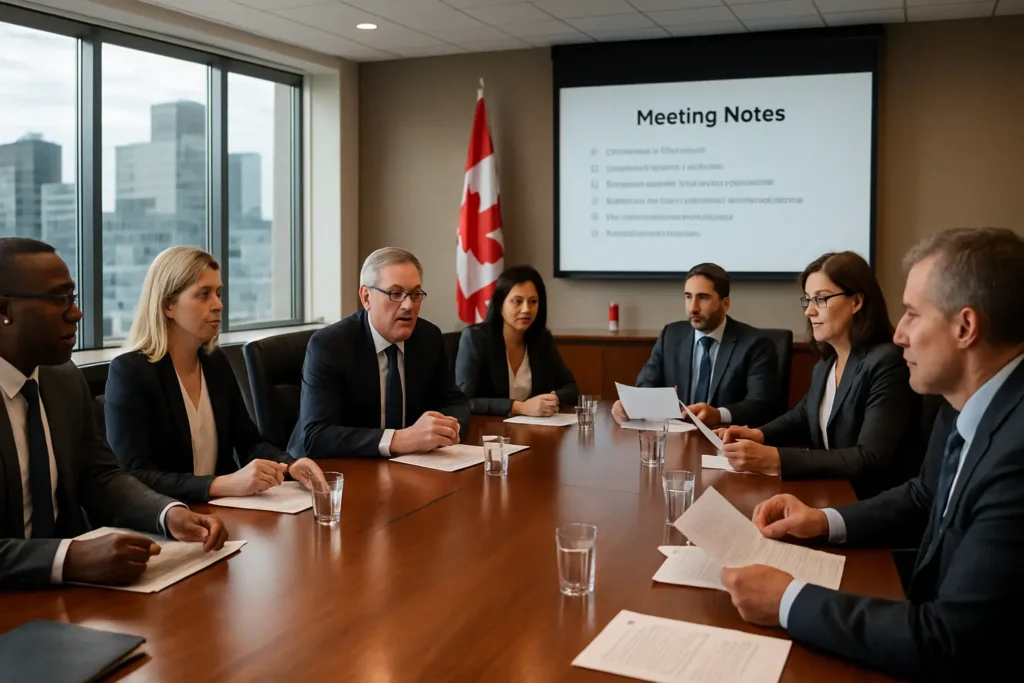
How to Make a Motion at a Board Meeting in Canada
Making a motion at a Canadian board meeting is a formal process. You must follow specific steps and understand parliamentary procedures.
To make a motion in Canada, first get recognized by the chairperson. Then state “I move” followed by your specific proposal, receive a second from another board member, and participate in any debate before the motion is put to a vote.
Whether you serve on a corporate board, nonprofit organization, or municipal committee, understanding the procedure ensures your voice is heard. This helps business run efficiently.
We’ll guide you through the legal framework that governs board meetings across Canada. Provincial regulations and organizational bylaws shape the motion process.
Understanding each participant’s role helps create productive meetings. This ensures your organization’s best interests are served.
The process exists to protect every board member’s right to contribute to decisions. Our guide will help you navigate parliamentary procedures, understand voting requirements, and master the etiquette that makes Canadian board meetings effective and legally compliant.
Understanding Motions in Canadian Board Meetings

Motions are the formal way to bring business before a Canadian board. Boards follow established parliamentary procedures to ensure fairness and proper documentation.
Definition and Purpose of Motions
A motion is a formal proposal by a board member that asks the group to take specific action. We use motions to introduce all business that needs board consideration or decision-making.
Motions focus discussion on one topic at a time. This prevents confusion and ensures we address each issue thoroughly before moving to the next item.
Key characteristics of effective motions:
- Specific – States exactly what action we want the board to take
- Clear – Uses simple language that all members understand
- Actionable – Proposes something the board has authority to do
We should state motions in positive terms whenever possible. For example, say “I move that we approve the proposal” instead of “I move that we do not reject the proposal.”
We document all motions in our meeting minutes. This creates a legal record of our decisions and actions.
Types of Motions Recognised in Canada
Canadian boards recognise several categories of motions based on parliamentary procedure. Each type serves a different purpose and follows specific rules for handling and voting.
Main motions introduce new business to the board. These form the foundation of our decision-making process and require the most discussion time.
Secondary motions help us handle main motions more effectively. We use these to amend, postpone, or refer items to committees for further study.
Procedural motions address how we conduct the meeting itself. These include motions to recess, extend debate time, or change the order of business.
Canadian boards also use unanimous consent for routine matters. This allows us to handle simple items quickly when no member objects.
The Parliament of Canada’s standing orders influence many of these procedures. Provincial legislation may also specify certain motion requirements for different organizations.
Substantive, Subsidiary and Privileged Motions
Substantive motions present the main business before our board. These motions propose specific actions, policies, or decisions that need board approval.
We debate substantive motions fully before voting. Examples include approving budgets, hiring staff, or changing organizational policies.
Subsidiary motions modify how we handle the main motion on the floor. Common subsidiary motions include:
- Amend – Changes the wording of the main motion
- Refer to committee – Sends the matter for detailed study
- Postpone – Delays consideration to a specific time
- Table – Sets aside temporarily without scheduling return
Privileged motions take priority over all other business because they affect the meeting or members directly. These include motions to adjourn, recess, or address urgent comfort issues.
The House of Commons follows similar precedence rules in its standing orders. Privileged motions interrupt other business and require immediate attention from the chair and members.
Legal Framework and Procedural Rules
Canadian boards must follow federal and provincial laws when making motions. They also follow their organization’s bylaws and standing orders.
Notice requirements vary by jurisdiction and organization type. There are specific timelines for different motion categories.
Applicable Laws and Bylaws
Federal corporations follow the Canada Not-for-profit Corporations Act or Canada Business Corporations Act. Provincial organizations comply with their respective corporate laws.
These laws set minimum standards for board meetings and decision-making processes. They define quorum requirements, voting thresholds, and record-keeping duties.
Key legal requirements include:
- Notice periods for board meetings
- Quorum calculations based on board size
- Voting procedures for different motion types
- Documentation standards for meeting minutes
Our organization’s bylaws provide more specific rules than general corporate law. Bylaws outline motion procedures, amendment processes, and special voting requirements.
We must ensure our bylaws comply with applicable provincial or federal legislation. If there is a conflict, legislation takes priority over bylaws.
Common bylaw provisions cover:
- Motion formats and seconding requirements
- Debate time limits and speaking order
- Committee referral procedures
- Emergency motion protocols
Role of Standing Orders and Order Paper
Standing orders establish permanent rules for conducting board meetings. These rules supplement Robert’s Rules and provide consistency across all meetings.
Standing orders address recurring procedural questions. They cover routine matters like meeting schedules, report formats, and standard motion categories.
Standing orders typically include:
- Regular meeting dates and times
- Standard agenda formats and item order
- Committee reporting schedules
- Routine motion approval processes
The order paper lists all business scheduled for upcoming meetings. We use this document to track pending motions, committee reports, and unfinished business items.
Our secretary maintains the order paper and updates it between meetings. This ensures we address all required business systematically.
Items stay on the order paper until we complete action or formally remove them through proper motion procedures.
Notice Requirements for Motions
Most routine motions require no advance notice when made during regular board meetings. Significant decisions often need formal notice to ensure proper consideration.
Notice periods vary by motion type:
| Motion Category | Notice Required |
| Routine business decisions | None |
| Bylaw amendments | 14-21 days |
| Special resolutions | 21 days |
| Budget approvals | 7-14 days |
We provide notice through formal notice papers distributed to all board members. Electronic distribution meets legal requirements in most Canadian jurisdictions.
The notice must include the exact wording of proposed motions. We cannot substantially change motions at the meeting without providing new notice.
Emergency motions may proceed without standard notice if two-thirds of members present agree to waive notice requirements. We use this only for urgent matters that cannot wait until the next regular meeting.
Provincial corporate law sets minimum notice periods that our bylaws cannot reduce. Our bylaws may require longer notice periods for specific motion types.
Step-by-Step Process to Make a Motion
To create a formal motion at a Canadian board meeting, prepare properly, give advance notice, and follow correct presentation procedures. This ensures all board members have time to review proposals and participate in decision-making.
Drafting and Submitting a Motion
We must write our motion using clear, specific language that states exactly what action we want the board to take. The motion should be brief but complete enough for members to understand the proposal.
Key elements to include:
- Specific action requested
- Timeline for implementation
- Financial implications (if any)
- Responsible parties
We submit the written motion to the board clerk or secretary before the meeting deadline. Most organizations require motions in writing to ensure accuracy in the meeting minutes.
The clerk reviews our submission for proper format and completeness. They may suggest revisions to improve clarity or ensure the motion aligns with the organization’s bylaws and procedures.
Giving Notice of Motion
We must provide advance notice for most motions according to our organization’s bylaws. Notice periods usually range from 24 hours to several weeks depending on the motion’s complexity and impact.
Common notice requirements:
- Routine business: 24-48 hours
- Policy changes: 1-2 weeks
- Budget matters: 2-4 weeks
- Bylaw amendments: 30+ days
The clerk includes our motion in the meeting agenda and distributes it to all board members. This gives everyone time to research the issue and prepare for discussion.
Emergency motions may bypass notice requirements if they address urgent matters that cannot wait until the next regular meeting. We must justify why the motion qualifies as an emergency.
Moving and Seconding a Motion
We begin by requesting recognition from the chairperson during the appropriate agenda item. Once recognized, we state our motion clearly: “I move that…” followed by the exact wording from our written submission.
Another board member must second our motion before discussion can begin. The seconder simply says “I second the motion” or “Second.”
The sequence follows this pattern:
- Recognition from the chair
- State the motion clearly
- Wait for a seconder
- Chair restates the motion
- Discussion and debate begin
If no one seconds our motion, it fails automatically without discussion or vote. The chair moves to the next agenda item.
Debate, Amendments and Voting on Motions
Once a motion reaches the floor, board members engage in structured debate before making decisions. Amendments allow us to modify proposals during discussion, while specific voting procedures ensure proper adoption of motions.
Debating Motions at the Board Meeting
Board members must wait for recognition from the chair before speaking on any motion. We cannot start talking without permission.
Debate must focus strictly on the motion’s merits. We cannot discuss unrelated topics or personal matters during this time.
Time limits often apply to individual speeches. Many boards set limits of 3-5 minutes per member to keep meetings efficient.
The chair controls the flow of debate. They decide who speaks next and ensure members follow proper procedures.
Speaking order typically alternates between supporters and opponents of the motion. This creates balanced discussion.
We can only speak once on each motion unless the board allows additional remarks. This prevents any single member from dominating the conversation.
The chair may close debate when no one else seeks the floor. They can also call for a vote to end discussion if debate becomes repetitive.
Amending Motions and Reasoned Amendments
We can modify motions during debate through the amendment process. We must move amendments while the main motion is still under discussion.
Making amendments requires us to state, “I move to amend the motion on the floor.” Another member must second the amendment before it proceeds.
We submit all amendments in writing to the chair. This helps ensure accuracy when the amended motion is read aloud.
Amendments must relate directly to the original motion. We cannot use amendments to introduce completely new topics.
Types of amendments include:
- Adding words to the motion
- Removing specific words
- Replacing certain words with different ones
We can debate only one amendment at a time. If our amendment passes, it becomes part of the main motion.
Reasoned amendments explain why we oppose a motion rather than just changing its wording. These are less common in board meetings but may be used in formal settings.
The amendment’s mover cannot amend their own proposal. They must withdraw it and propose a new amendment instead.
Voting Procedures and Adoption of Motions
The chair calls for a vote once debate ends on both the motion and any amendments. We vote on amendments first, then vote on the main motion.
Voice votes are most common in board meetings. The chair asks for “all in favour” and then “all opposed.”
If the voice vote result is unclear, any member can request a recorded vote. This creates an official record of how each person voted.
A simple majority adopts most motions. More than half of the members present must vote in favour.
Quorum requirements must be met for valid voting. We cannot adopt motions without enough members present as defined in our bylaws.
The chair announces the result immediately after voting. They state whether the motion carried or failed.
Adopted motions become official board decisions. The secretary records them in the meeting minutes for future reference.
Some special motions require higher vote thresholds. Bylaw changes often need two-thirds majority approval instead of a simple majority.
Roles and Responsibilities in Board Meetings
Each person at a board meeting has specific duties that keep discussions organized and decisions valid. The chair guides the meeting, while committees provide research and recommendations to help the board make informed choices.
Chair, Speaker and Clerk Duties
The chair leads the meeting and stays neutral during discussions. We rely on the chair to recognize speakers, restate motions clearly, and ensure proper voting procedures.
The chair calls meetings to order and follows the agenda. They manage time and keep discussions focused on current motions.
When members raise points of order, the chair makes rulings on procedures.
Key chair responsibilities include:
- Maintaining order during debates
- Preventing members from going off-topic
- Calling for votes at appropriate times
- Ensuring fair participation for all members
The clerk (or secretary) prepares meeting materials and keeps official records. The clerk distributes agendas at least one week before meetings and conducts roll call to confirm attendance.
During meetings, the clerk records all motions, voting results, and key discussion points. The clerk prepares draft minutes for approval at the next meeting.
Essential clerk duties involve:
- Taking accurate meeting minutes
- Managing official correspondence
- Maintaining board documents and records
- Tracking follow-up actions from decisions
Role of Committees and Committee Reports
Committees handle detailed work between board meetings and report their findings to help inform board decisions. Standing committees address ongoing business like finance or governance. Special committees focus on specific tasks.
Committee chairs lead their groups using similar procedures as board meetings. They prepare written reports summarizing activities, findings, and recommendations for board action.
Effective committee reports include:
- Summary of work completed since last meeting
- Key findings or progress updates
- Specific recommendations requiring board votes
- Timeline for next steps or project completion
The committee of the whole allows the entire board to discuss complex issues informally before making formal decisions. This format encourages open discussion without strict parliamentary procedures.
Legislative committees in government settings review proposed laws and regulations. These committees examine details and make recommendations to the full legislative body.
We schedule committee reports after approving minutes but before new business. This gives context for upcoming decisions and helps streamline the voting process.
Interaction with the Legislative and Governance Process
Board motions in Canada connect to our broader parliamentary system through formal legislative procedures and Crown oversight. Government bills follow specific stages from first reading to royal assent. The Governor General and Senate provide constitutional review of all parliamentary decisions.
How Motions Relate to Bills and the Legislative Process
Board motions at government agencies and Crown corporations directly influence how government bills develop in Parliament. When we pass motions about policy recommendations, these decisions often become the foundation for legislative proposals.
Private members’ bills can also originate from board recommendations. Individual MPs use our motion outcomes to draft legislation on specific issues we identify.
The Department of Justice reviews our motions when they involve legal matters. Legislative counsel helps turn our decisions into proper bill language for Parliament.
Key connections include:
- Policy motions become government bill content
- Budget motions influence supply bills requiring royal recommendation
- Regulatory motions lead to orders of the Governor in Council
We work with the Privy Council Office when our motions affect public funds or federal operations. Our decisions must align with existing parliamentary authority.
Private members’ business often reflects concerns we raise through board motions. MPs present these issues during designated sitting times.
Stages of a Bill: First Reading to Royal Assent
Our motions follow similar stages to parliamentary bills as they move through the legislative process. Understanding these stages helps us structure our governance decisions effectively.
First reading introduces the bill title and basic concept to Parliament. This mirrors how we introduce new business motions for initial board consideration.
Second reading involves detailed debate on the bill’s principles. We have similar discussions when debating substantive motions about organizational direction.
Clause-by-clause review happens in parliamentary committees. Our board committees perform similar detailed analysis of complex motions before recommending action.
Report stage allows amendments based on committee findings. We modify our motions based on committee recommendations following the same principle.
Third reading provides final debate before voting. Our final motion discussions serve this same purpose in board governance.
Senate consideration adds another review layer for all House of Commons legislation. Some provincial boards include similar second-chamber review processes.
Oversight by the Crown and Governor General
The Governor General represents the Crown’s constitutional role in our legislative system. All bills require royal assent from the Governor General to become law.
Our board motions involving federal agencies must consider Crown prerogatives. The Governor in Council has final authority over many policy areas we address.
Senate review ensures regional and minority interests receive consideration. This parallels how we protect minority board member rights during motion procedures.
Parliament’s authority flows from the Crown through constitutional convention. Our governance structures reflect this same hierarchical accountability.
Key oversight mechanisms:
- Royal assent finalizes all legislation
- Governor in Council orders implement policy decisions
- Senate provides regional perspective and sober second thought
- Crown corporations report through ministerial responsibility
Parliamentary proceedings follow established conventions that mirror Robert’s Rules procedures. We maintain similar formality in our board governance to ensure legitimate decision-making authority.
Conclusion
Making a motion at a Canadian board meeting follows clear steps. We get recognized by the chair, state our motion, and wait for a second.
Discussion happens before voting. Good motions are specific and include all key details.
We should mention timelines, costs, and how things will be funded. This prevents confusion and saves time during meetings.
At OrgHub.ca, we help Canadian boards run better meetings. Our platform makes it easier to track motions, record votes, and manage all your board work in one place.
Frequently Asked Questions
Board members often need quick answers about motion procedures during meetings. These common questions cover the basic steps, proper wording, and different types of motions used in Canadian board meetings.
How do you do a motion in a board meeting?
First, raise your hand and wait for the chairperson to recognize you. Once acknowledged, clearly state your motion using “I move that…” followed by your specific proposal. Another board member must second the motion. The chairperson then restates the motion, discussion follows, and finally, we vote. The chairperson asks, “All in favour?” then “All opposed?” and we record the results in the minutes.
What are the words to make a motion?
Always begin with “I move that…” when proposing new business. Examples include “I move that we approve the annual budget of $250,000” or “I move that we hire a new executive director.” State your motion in positive terms and be specific. Vague motions like “I move that we do something about the budget” don’t help with clear decision-making.
What do you say to make a motion?
Use “I move that…” for new business, followed by your complete proposal. To support someone else’s motion, say “I second the motion” or simply “Second.” Common phrases include “I move to table this motion,” “I move to amend the motion by…” or “I move to refer this to the finance committee.” You can say “I call the question” to end the discussion and vote, which requires a two-thirds majority.
What are the 5 types of motions in a board meeting, and which is most important?
The five main types are: Main motions (introduce new business), Subsidiary motions (help handle main motions through amendments or postponements), Privileged motions (address urgent meeting conditions), Incidental motions (resolve procedural questions), and Renewal motions (bring back previously decided matters). Main motions are most important because they drive all board decisions and form the foundation of board work.
What are the basics of making motions?
You need three basic elements: recognition from the chairperson, clear wording, and a second from another member. Wait for the chair to acknowledge you, use “I move that…” format, state one clear proposal, and get someone to second it. Discuss only one main motion at a time and resolve it before introducing new business. You can modify motions through amendments before voting.
Could you outline the differences between a main motion and a subsidiary motion in the context of a Canadian board meeting?
Main motions introduce new business that needs board action, like budgets or policy changes. Only one main motion can be discussed at a time, and it requires a majority vote to pass. Subsidiary motions work with main motions to guide decision-making and help improve proposals. You cannot make subsidiary motions unless a main motion is already on the floor. Common subsidiary motions include amendments, postponements, and committee referrals. We vote on subsidiary motions first, then return to the main motion for the final decision.