
Quick Answer
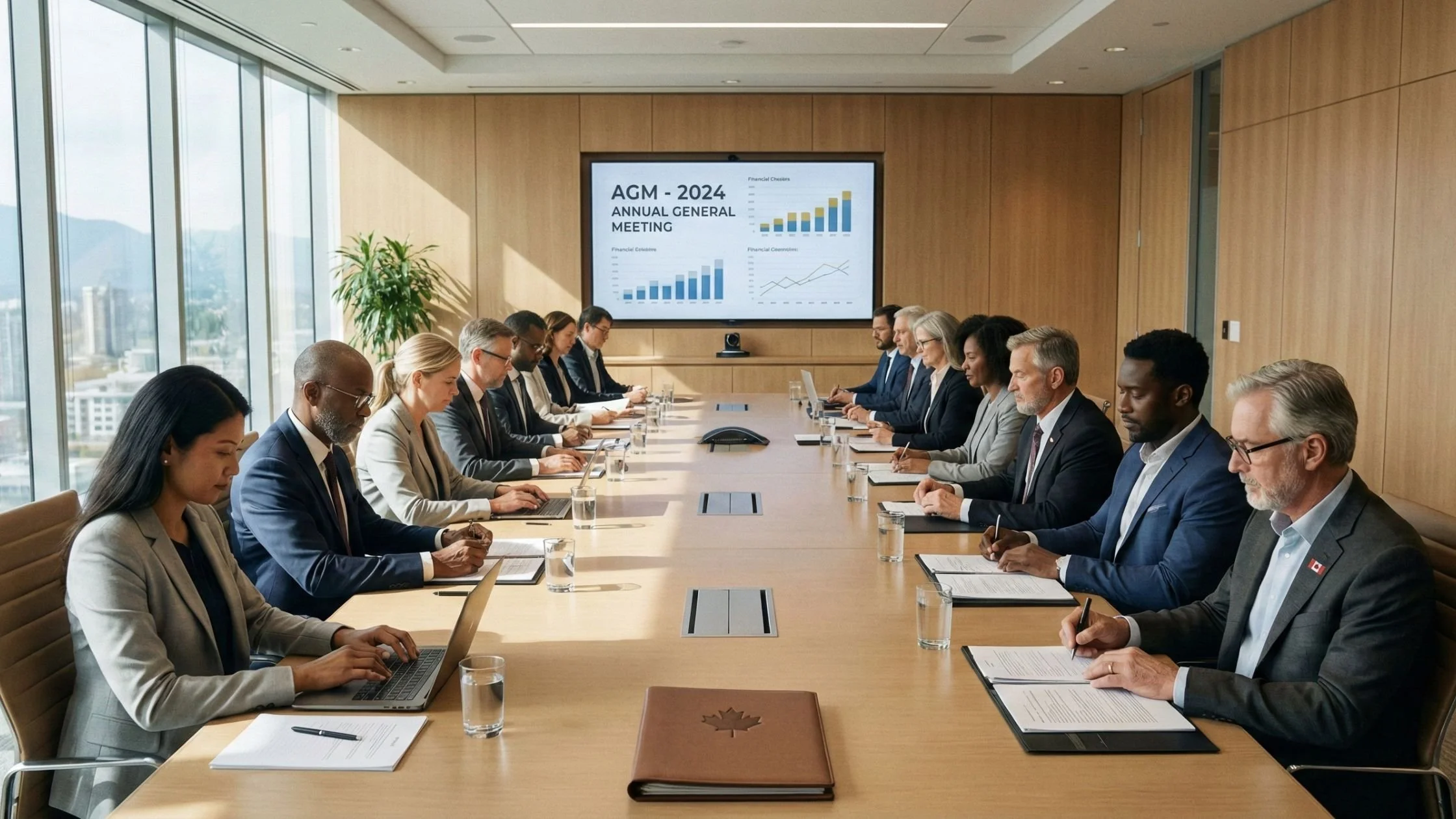
An annual general meeting (AGM) is the yearly meeting where a charity's voting members receive the financial statements, elect directors and appoint (or waive) a public accountant. The CNCA and ONCA call it an “annual meeting of members.”
The rules depend on where the charity is incorporated:
- Federal (CNCA): hold the AGM within 15 months of the last one and no later than 6 months after fiscal year-end. Give members 21 to 60 days' notice.
- Ontario (ONCA): the same 15-month and 6-month timing applies, but notice is 10 to 50 days.
- British Columbia: societies must hold an AGM every calendar year.
Key Takeaways
Timing (federal): first AGM within 18 months of incorporation. After that, within 15 months of the last AGM and within 6 months of fiscal year-end, whichever comes first.
Notice: CNCA 21 to 60 days (21 to 35 days if sent electronically). ONCA 10 to 50 days. BC 14 days unless the bylaws say otherwise (minimum 7, maximum 60).
Financial statements: CNCA corporations send them to members 21 to 60 days before the AGM. ONCA corporations send them, or a summary, at least 5 days before.
Small memberships: federal corporations can replace the AGM with a written resolution signed by every voting member.
Online AGMs: Ontario allows virtual and hybrid meetings by default unless your articles or bylaws say otherwise. Federally, a fully virtual AGM needs a bylaw provision. A 2026 federal consultation proposes making virtual meetings the default.
Minutes: CRA requires registered charities to keep members' meeting minutes for as long as they're registered, plus two years after revocation.
What Is an Annual General Meeting?
An annual general meeting is a mandatory yearly meeting of a charity's members, the people or organizations with voting rights under its bylaws. It's where the board accounts to the members for the past year.
An AGM is not a board meeting. Directors meet throughout the year to govern the charity. Members meet at least once a year to:
Receive the financial statements and the public accountant's report
Elect directors
Appoint or waive a public accountant
Vote on bylaw changes and other matters that need member approval
Many smaller charities have only a few members, and sometimes the directors are also the only members. The legal requirements still apply. Only the format gets simpler.
Why the AGM Matters
The AGM is a charity's main accountability moment. Members see how donations and grants were used, question the board, and decide who governs next. For a deeper look at this, see our guide to the purpose of an annual general meeting for a charity.
A well-run AGM also produces the paper trail that funders, auditors and the Canada Revenue Agency (CRA) expect. That includes valid director elections, a properly appointed accountant, and approved minutes. It's also one of the ways directors meet their fiduciary duty to the organization.
Does Your Charity Have to Hold an AGM?
It depends on your charity's legal structure.
Incorporated charities have to hold one. That covers charities incorporated federally under the Canada Not-for-profit Corporations Act (CNCA), in Ontario under the Not-for-Profit Corporations Act, 2010 (ONCA), or under another provincial non-profit statute. The requirement comes from corporate law, not from the CRA.
Charitable trusts and unincorporated associations follow their own trust deed or constitution. Many of these documents require an annual meeting too. If you're not sure how your organization is structured, see board of trustees vs. board of directors.
Small memberships have a shortcut. A federal not-for-profit corporation can pass a written resolution signed by all members entitled to vote instead of holding the meeting. The resolution must still deal with everything the AGM would have covered, including the financial statements, directors and public accountant. Organizations in other jurisdictions should check their statute and bylaws before using this option.
AGM Requirements in Canada by Jurisdiction (2026)
| Requirement | Federal (CNCA) | Ontario (ONCA) | British Columbia (Societies Act) |
|---|---|---|---|
| Later AGMs | Within 15 months of the last AGM and within 6 months of fiscal year-end | Within 15 months of the last AGM and within 6 months of fiscal year-end | Once every calendar year |
| First AGM | Within 18 months of incorporation | Check your statute and bylaws | Not required in the calendar year of incorporation |
| Notice to members | 21–60 days (mail, courier, in person); 21–35 days (electronic) | 10–50 days | 14 days by default; bylaws can set 7–60 days |
| Financial statements to members | 21–60 days before the AGM | At least 5 days before (full statements or a summary) | Presented at the AGM |
| Government filing of financial statements | Soliciting corporations file with Corporations Canada at least 21 days before the AGM | None; annual return through the Ontario Business Registry | Annual report to the registrar |
| Virtual or hybrid AGM | Electronic participation allowed unless bylaws prohibit it; a fully virtual meeting needs a bylaw provision | Allowed by default unless articles or bylaws say otherwise (since October 1, 2023) | Check your bylaws |
| Proxy voting | Only if bylaws allow it | Only if articles or bylaws allow it | Check your bylaws |
| Members can force a meeting | Members with 5% of votes can requisition one | Members with 10% of votes can requisition one | Members can requisition a general meeting |
For a full list of federal filing deadlines, see the checklist of annual obligations under the CNCA. Ontario charities can review the critical points for holding an annual members' meeting under ONCA. BC societies can check the Clicklaw guide to Societies Act meetings.
Other provinces and territories have their own statutes. Quebec OBNLs incorporated under Part III of the Companies Act rely largely on their bylaws. Check your incorporating statute and bylaws. Where the two differ, the statute's minimums always apply.
Federal charities follow federal rules in every province where they operate. Provincial corporations follow their home province's rules even if they operate in several provinces. Starting a new organization in Ontario? See how to register a nonprofit in Ontario.
How to Calculate Your AGM Deadline (Worked Example)
Under the CNCA and ONCA, your deadline is whichever of two dates comes first:
15 months after your last AGM
6 months after your fiscal year-end
Example: a federal charity's fiscal year ends March 31, 2026, and its last AGM was September 15, 2025.
6 months after year-end: September 30, 2026
15 months after the last AGM: December 15, 2026
Deadline: September 30, 2026, the earlier date
To hold the AGM on September 30, 2026:
Notice by mail: send it no earlier than August 1 and no later than September 9.
Notice by email: send it no earlier than August 26 and no later than September 9.
Build in a few extra days. A notice that arrives one day late can put every vote at the meeting at risk.
AGM Preparation Checklist
90 or more days before
Confirm your AGM deadline using the method above.
Book your auditor or review engagement accountant.
Check which director terms are ending.
Review your bylaws for notice, quorum, proxy and virtual-meeting rules.
60 days before
The board approves the financial statements.
The board sets a record date if your bylaws or statute allow one.
Update the member register.
Collect any member proposals. Under the CNCA, proposals received 90 to 150 days before the anniversary of the last AGM must be included in the notice.
At least 21 days before (CNCA) or 10 days before (ONCA)
Send the notice of meeting, the agenda, the full text of any special resolutions, the nominations, and joining instructions for virtual attendees.
CNCA corporations send the financial statements in the same 21–60 day window.
Soliciting CNCA corporations also file them with Corporations Canada.
At least 5 days before (ONCA)
Make sure members have the financial statements or a summary.
One week before
Test the virtual platform and the voting tool.
Send a reminder to help reach quorum.
AGM day
Confirm quorum.
Work through the agenda.
Record every motion and every vote.
After the AGM
Report director changes to Corporations Canada or the Ontario Business Registry.
Draft the minutes and store them permanently.
Standard AGM Agenda for a Canadian Charity
Call to order and chair's welcome
Confirmation of notice and quorum
Approval of the agenda
Approval of the previous AGM's minutes
Chair's and Executive Director's reports
Presentation of the financial statements and the public accountant's report
Appointment of the public accountant, or a resolution to waive the appointment or choose a review engagement
Election of directors
Special resolutions, such as bylaw amendments
Member proposals
Questions from members
Adjournment
Routine items like approving the agenda and previous minutes can be grouped together. See what a consent agenda is and how it works.
Quorum, Voting and Member Rights
Quorum. If the bylaws are silent, CNCA quorum is a majority of the members entitled to vote. Most charities set a lower, workable number in their bylaws. Without quorum, the only valid motion is to adjourn. Learn more about quorum rules in Canada.
Types of resolutions:
Ordinary resolution: more than 50% of votes cast.
Special resolution: at least two-thirds of votes cast. Used for bylaw and article amendments and some audit choices.
Extraordinary resolution (ONCA): at least 80% of votes cast. Used for audit and review engagement waivers.
For step-by-step guidance on motions and ballots, see nonprofit board voting procedures.
Record date. A record date decides which members are entitled to notice of the meeting. Your statute and bylaws set when it can be fixed. Members who join after the record date may not receive notice of that meeting.
Members don't approve the financial statements. The directors approve them. Members receive them, ask questions, and vote on the public accountant.
Member proposals. Members can put items on the agenda by following their statute's proposal process. Under ONCA, a corporation that refuses a proposal must tell the member why within 10 days of receiving it.
Financial Statements, Audits and Review Engagements
What your charity must present at the AGM depends on its statute and revenue.
Federal Charities (CNCA)
A soliciting corporation is one that receives more than $10,000 a year in public donations or government grants. See soliciting vs. non-soliciting corporations for how the test works.
| Corporation type | Gross annual revenue | Requirement |
|---|---|---|
| Soliciting | $50,000 or less | Review engagement by default. Members can waive a public accountant only by unanimous consent. |
| Soliciting | $50,000 to $250,000 | Audit, or a review engagement by special resolution |
| Soliciting | Over $250,000 | Audit required |
| Non-soliciting | $1 million or less | Review engagement by default. Members can waive a public accountant only by unanimous consent. |
| Non-soliciting | Over $1 million | Audit required |
The timing for sending financial statements to members is set out in the Canada Not-for-profit Corporations Regulations.
Ontario Charities (ONCA)
Every charitable corporation in Ontario is a public benefit corporation.
| Gross annual revenue | Requirement |
|---|---|
| $100,000 or less | Audit and review can both be waived by extraordinary resolution (80%) |
| $100,000 to $500,000 | Review engagement instead of audit by extraordinary resolution |
| Over $500,000 | Audit required |
For more detail, see financial reporting obligations under ONCA.
Important: waivers and review engagement resolutions last only until the next AGM. They must be passed again every year.
Electing Directors at the AGM
Elections and terms. Directors are elected at the AGM for the terms set in your bylaws. Staggered terms keep continuity.
Ontario consent rule. Under ONCA, newly elected directors must consent in writing before their election or within 10 days after it. Directors re-elected with no break in office don't need to consent again.
Report changes. Federal charities report director changes to Corporations Canada within 15 days. Ontario charities file a notice of change through the Ontario Business Registry.
If no election is held. The incumbent directors generally continue until their successors are elected. That's another reason not to let an AGM lapse.
New board members can get up to speed with what a board of trustees does in a charity.
Virtual and Hybrid AGMs in 2026
Ontario. Amendments that took effect October 1, 2023 make virtual and hybrid meetings available by default unless your articles or bylaws say otherwise. ONCA corporations had until October 2024 to update their governing documents. After that, the documents were deemed amended to comply. CLEO summarizes the recent changes to ONCA.
Federal. The CNCA allows members to join an in-person meeting electronically unless the bylaws prohibit it. A meeting held entirely online needs a bylaw provision. Any electronic voting method must preserve ballot secrecy where a secret vote is required.
British Columbia. The province publishes guidance on electronic meetings under the Societies Act.
What's changing. In 2026, Innovation, Science and Economic Development Canada (ISED) consulted on CNCA amendments, including making virtual and hybrid meetings available by default. You can read the ISED consultation paper. The consultation closed June 5, 2026. These are still proposals, not law. Until amendments pass, check your bylaws before planning a fully virtual AGM.
Best practices for online AGMs:
Use a platform that verifies members and supports secure voting.
Send joining instructions with the meeting notice.
Assign a moderator to handle technical issues and the chat.
Have a phone dial-in backup.
Record in the minutes how votes were counted.
What Happens If a Charity Misses Its AGM Deadline?
Missing an AGM doesn't automatically revoke charitable registration. It does cause problems that build on each other.
Members can act. They can requisition a meeting (5% of votes under the CNCA, 10% under ONCA) or apply to court. CLEO explains how Ontario members can call a special meeting.
Decisions become vulnerable. Expired director terms, an unappointed accountant, and unapproved audit waivers can all be challenged.
Federal filing risk. The annual return reports your last meeting date. A CNCA corporation that stops filing annual returns can be dissolved. Corporations Canada's policy is to dissolve only after three years of non-filing, and it gives a final 120-day warning first.
CRA exposure. Missing minutes and records can lead to suspension of receipting privileges or revocation.
How to get an extension:
Federal: apply to Corporations Canada before the deadline for an order extending the time to call the AGM.
BC: request an extension from the registrar between November 1 and December 31 of the year the AGM was due.
Ontario: speak with a lawyer about your options.
If you've already missed it: hold the meeting as soon as possible, give proper notice, and record the circumstances in the minutes.
AGM Minutes and Record-Keeping
The minutes are the legal record of the AGM. They should show:
The date, time and format (in person, hybrid or virtual)
Attendance and confirmation of quorum
Confirmation that proper notice was given
Each motion, who moved it, and the result
Election results and the public accountant decision
How long to keep them:
Members' and directors' minutes, and governing documents: for as long as the charity is registered, plus two years after revocation. Treat them as permanent.
Financial records: six years.
See the CRA's checklist for keeping adequate books and records and our overview of the CRA Charities Directorate books and records guide.
The minutes are approved at the next AGM. Many charities also have the board review a draft shortly after the meeting so it's accurate while memories are fresh.
Common AGM Mistakes (and How to Avoid Them)
Using the wrong notice period. CNCA and ONCA rules differ, and so do mail and email windows.
Missing the 6-month deadline because you only tracked the 15-month one.
Forgetting to renew audit waivers. They expire at every AGM.
Holding a fully virtual federal AGM without a bylaw that allows it.
Letting proxies vote when the bylaws don't provide for them.
Leaving special resolution text out of the notice.
Asking members to "approve" the financial statements instead of receiving them.
Keeping incomplete minutes, or throwing them away after six years.
How OrgHub Helps
OrgHub helps Canadian charities and nonprofits:
Track AGM deadlines based on fiscal year-end and last meeting date
Manage member registers
Send meeting notices
Organize board and members' meetings
Store minutes permanently
Get started for free or contact the OrgHub team. Already running a nonprofit? See how OrgHub can help you manage your nonprofit. Starting a new organization? Incorporate your nonprofit with OrgHub and set up compliant governance from day one.
This article is general information, not legal advice. Confirm your obligations against your governing statute and bylaws.
Frequently Asked Questions
Is an AGM legally required for a charity in Canada?
Yes, if the charity is incorporated. The CNCA, ONCA and provincial non-profit statutes require an annual meeting of members. Unincorporated charities follow their own constitution or trust deed.
How much notice is required for an AGM in Canada?
CNCA: 21 to 60 days by mail or in person, or 21 to 35 days electronically.
ONCA: 10 to 50 days.
BC Societies Act: 14 days unless the bylaws set between 7 and 60 days.
Your bylaws can require more notice than the statute, but not less.
What is the deadline for holding an AGM?
For CNCA and ONCA corporations, the earlier of 15 months after the last AGM or 6 months after fiscal year-end. BC societies must hold one every calendar year.
Can a charity skip the AGM if all members agree?
Federally, yes. A written resolution signed by all voting members can replace the meeting. It must still deal with the financial statements, the directors and the public accountant.
Can a Canadian charity hold its AGM online?
Ontario charities can by default unless their articles or bylaws say otherwise. Federal charities need a bylaw provision for a fully virtual AGM. Members can join an in-person meeting electronically unless the bylaws prohibit it.
Do members vote to approve the financial statements?
No. Directors approve the financial statements. Members receive them, ask questions, and vote on the public accountant.
What happens if quorum isn't reached?
The meeting can only adjourn. Check your bylaws for rules on the adjourned meeting.
What is the difference between an AGM and a board meeting?
An AGM is a meeting of members, held once a year, with set legal business. Board meetings are meetings of directors, held as often as needed to govern the charity.
How long must a charity keep AGM minutes?
For as long as it's a registered charity, plus two years after revocation. In practice, keep them permanently.