
Nonprofit Board Voting Procedures in Canada: Best Practices
Every nonprofit board in Canada must follow specific voting procedures to make legal decisions and maintain proper governance. These procedures aren’t just suggestions; they’re legal requirements that protect your organization and ensure fair decision-making.
Understanding Canadian nonprofit board voting procedures helps organizations comply with federal and provincial laws while creating transparent processes that strengthen board effectiveness.
Getting your voting procedures right affects everything from daily board decisions to director elections. We’ll walk you through the essential elements of Canadian nonprofit voting procedures, including how to establish clear policies, understand your legal obligations, and implement best practices that work for your specific situation.
Updates to Canadian Nonprofit Voting Requirements
Recent Changes Affecting Board Voting
Canadian nonprofit voting procedures have evolved significantly in 2024-2025, with several key developments affecting how boards conduct votes:
Permanent Virtual and Hybrid Meeting Provisions: Following temporary pandemic measures, most provinces have now permanently codified virtual meeting procedures. Organizations can conduct board votes through video conferencing platforms without requiring in-person attendance, provided bylaws permit this method.
Enhanced Electronic Voting Security: The Canada Revenue Agency (CRA) issued updated guidance in late 2024 requiring nonprofits using electronic voting platforms to implement multi-factor authentication and maintain detailed audit trails. These requirements apply to both board votes and member votes.
Provincial Legislative Updates:
- Ontario: ONCA amendments clarified that proxy voting rules for board members differ from member voting rights
- British Columbia: New Societies Act regulations strengthened conflict of interest disclosure requirements before votes
- Alberta: Updated requirements for documenting virtual meeting attendance and vote participation
Court Precedents: Several 2024 Ontario Superior Court cases reinforced that improper voting procedures can invalidate board decisions, even years after the fact. These cases emphasized the importance of:
- Verifying quorum before each vote
- Properly documenting abstentions and conflicts of interest
- Maintaining written records of electronic votes
Canada Revenue Agency Compliance Reminders: The CRA issued updated guidance requiring charities to demonstrate democratic governance through transparent voting procedures. This affects charitable registration and annual filings.
Overview of Nonprofit Board Voting Procedures in Canada
Federal and provincial legislation governs nonprofit board voting procedures in Canada. These rules ensure fair representation of members and maintain transparency in organizational governance.
Legal Framework for Voting Processes
Two main pieces of legislation govern Canadian nonprofit voting procedures. The Canada Not-for-profit Corporations Act (CNCA) applies to federally incorporated organizations.
Provincial acts like the Ontario Not-for-Profit Corporations Act (ONCA) govern provincially incorporated nonprofits.
These acts provide flexibility in voting procedures but set minimum requirements. Organizations must follow their bylaws and articles of incorporation when conducting votes.
Key legal requirements include:
- Directors must be elected by members at annual meetings
- Candidates need 50% + 1 of votes cast to win
- Members controlling 5% of votes can nominate directors
- Virtual meetings are permitted unless bylaws prohibit them
The legislation lets nonprofits choose between individual candidate voting or slate voting. Any member can request individual voting even when slate voting is proposed.
Organizations must file a Notice of Change when directors change after elections. If boards don’t follow proper procedures, members may challenge the elections in court.
Purpose and Significance of Board Voting
Board voting is the primary mechanism for democratic governance in not-for-profit corporations. It ensures members have a voice in selecting leadership aligned with the organization’s mission and values.
The voting process maintains accountability between the board of directors and the membership. This relationship is essential for nonprofit legitimacy and public trust.
Voting procedures accomplish several critical functions:
- Select qualified directors who represent member interests
- Ensure fair representation across different member classes
- Maintain organizational continuity through regular elections
- Provide a mechanism for removing underperforming directors
Proper voting procedures protect the organization from legal challenges and ensure compliance with regulatory requirements.
For self-perpetuating boards where directors are the only members, separate member meetings must still occur. This maintains the legal distinction between board governance and member oversight.
Key Participants in the Voting Process
Several groups play specific roles in the voting process. Members form the foundation of the democratic process as the primary voting body in not-for-profit corporations.
Voting members have the right to:
- Nominate candidates for director positions
- Cast ballots in elections
- Request individual voting instead of slate voting
- Challenge election results in court if procedures were improper
Current directors can vote if they are also voting members. Directors may appoint up to one-third of elected directors to fill vacancies between annual meetings.
Election committees may oversee the process, though they are not legally required. These committees ensure fair treatment of all candidates and proper vote counting.
Proxy holders can vote on behalf of members if the bylaws permit proxy voting. Proxy forms must be submitted according to board-set deadlines.
The chair of the meeting manages the voting process and ensures procedures follow the bylaws and applicable legislation.
Establishing Voting Methods and Policies

Canadian nonprofit boards must create clear voting procedures that define who can vote and how decisions are made. These policies ensure fair participation and protect the organization’s legal standing.
Determining Voting Eligibility
We need to establish who has voting rights within our nonprofit organization. The bylaws must clearly state which board members can participate in voting decisions.
Elected Directors typically receive full voting privileges. These board members are chosen through our formal election process.
Ex-officio Members may or may not have voting rights. We must specify this in our bylaws.
Some organizations grant voting rights to ex-officio members like the executive director. Others limit them to advisory roles only.
Honorary Members usually do not receive voting privileges. These positions recognize contributions but don’t include decision-making power.
We should document voting eligibility clearly to avoid confusion during board meetings. Members must understand their rights before participating in any voting process.
Types of Voting Methods Used by Boards
Canadian nonprofits can use several voting methods during board meetings. Each method serves different situations and organizational needs.
Voice Voting works well for routine decisions. Board members say “yes” or “no” aloud, and the chair determines the outcome based on which response sounds louder.
Show of Hands provides a visual count of votes. Members raise their hands to indicate their choice.
Secret Ballot protects member privacy on sensitive issues. We distribute paper ballots or use electronic systems to prevent influence from other board members.
Roll Call Voting creates a public record of each member’s vote. The secretary calls each name and records their response.
Electronic and Remote Voting Options
Technology allows Canadian nonprofit boards to vote outside traditional in-person meetings. We must follow specific rules when using these methods.
Email Voting lets members cast votes electronically between meetings. Our bylaws must specifically allow this method.
We need clear deadlines and response requirements for email voting. Video Conference Voting enables remote participation in real-time meetings.
Members can vote during live video calls using voice or chat features. Online Voting Platforms provide secure digital voting systems that track responses and maintain records automatically.
We must ensure the platform meets our privacy requirements. Telephone Voting allows participation through conference calls, with members voting verbally during the call.
The secretary must record all responses accurately. We must establish clear policies for electronic voting before implementing these methods.
Our bylaws should address technical requirements and backup procedures.
Step-by-Step Board Voting Process
Place this as a NEW section after “Establishing Voting Methods and Policies” and before “Role of Bylaws”
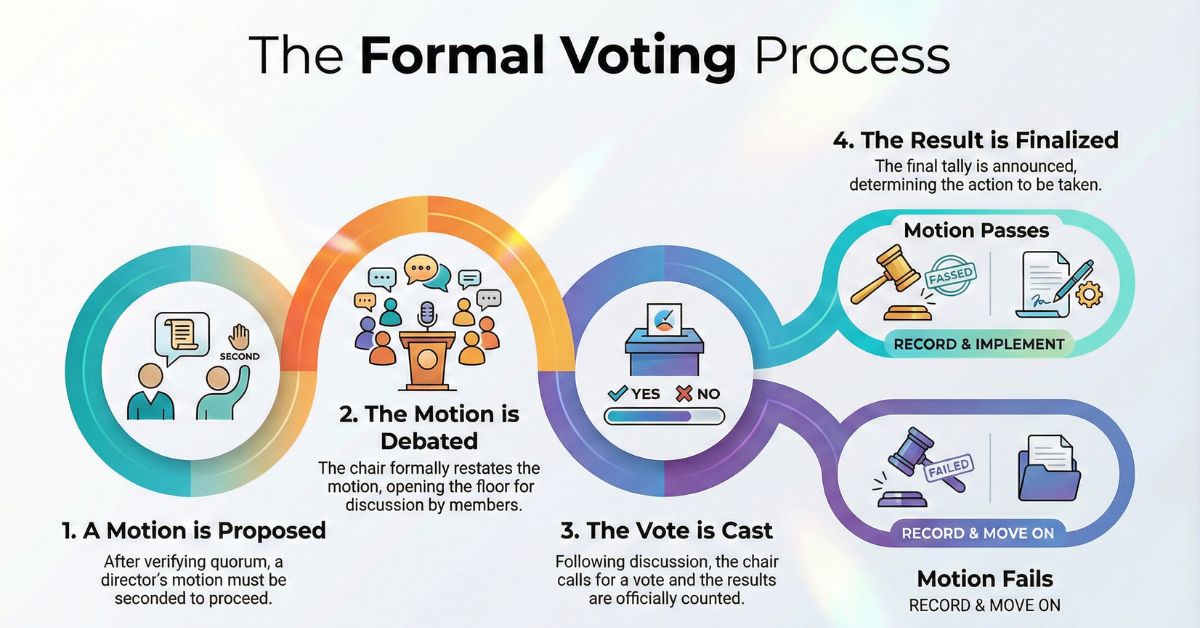
Understanding the exact sequence of a board vote ensures your organization follows proper procedures and creates valid, legally binding decisions.
The Complete Voting Procedure
Step 1: Verify Quorum Before any voting begins, the chair or secretary must confirm that quorum is present. Count all directors present (in-person and virtual). If quorum is not met, the meeting cannot proceed to voting.
Step 2: Present the Matter for Discussion The chair introduces the topic requiring a decision. Directors discuss the matter, ask questions, and seek clarifications. The chair ensures all directors who wish to speak have the opportunity.
Step 3: Call for a Motion When discussion concludes, the chair asks: “Is there a motion?” A director makes a motion by stating: “I move that [specific action to be taken].”
Example motions:
- “I move that we approve the 2025 budget as presented.”
- “I move that we accept the auditor’s report.”
- “I move that we appoint Jane Smith as interim treasurer.”
Step 4: Second the Motion Another director must second the motion by saying: “I second the motion.” If no one seconds the motion, it dies and cannot be voted on.
Step 5: Restate the Motion The chair restates the exact motion for clarity: “It has been moved and seconded that [restate motion]. Is there any further discussion?”
Step 6: Final Discussion Directors may discuss the motion further. Directors can propose amendments to the motion at this stage. Amendments require a mover, seconder, and vote before returning to the main motion.
Step 7: Call the Vote When discussion ends, the chair calls for the vote: “All those in favour?” then “All those opposed?” then “Any abstentions?”
Step 8: Conduct the Vote Directors vote using the predetermined method:
- Voice vote: Say “aye” or “nay”
- Show of hands: Raise hand to indicate vote
- Roll call: Secretary calls each name and records individual votes
- Secret ballot: Directors mark paper ballots or use electronic system
- Electronic poll: Directors select their vote on virtual platform
Step 9: Count and Announce Results The chair or secretary counts votes and the chair announces: “The motion carries” or “The motion fails.” For roll call votes, announce the vote tally (e.g., “5 in favour, 2 opposed, 1 abstention”).
Step 10: Record the Vote The secretary immediately records in the minutes:
- Exact wording of the motion
- Names of the mover and seconder
- Vote result (passed or failed)
- Vote count if it was a counted vote
- Names of directors voting against or abstaining (if requested)
- Time the vote occurred
Step 11: Handle Post-Vote Actions If the motion passes, the chair may assign implementation responsibilities: “The treasurer will prepare the revised budget for distribution by [date].”
Step 12: Move to Next Agenda Item The chair proceeds: “The motion has been carried. We will now move to the next item on our agenda.”
Special Voting Scenarios
Handling Tie Votes: When votes are equally divided:
- Check your bylaws for tie-breaking procedures
- Most bylaws give the chair a tie-breaking vote
- Some bylaws state that tie votes mean the motion fails
- In the absence of bylaws guidance, the motion typically fails
Emergency Voting Between Meetings: Some matters cannot wait for the next scheduled meeting:
- Use written consent resolutions signed by all directors
- Conduct an emergency meeting with shortened notice (check bylaws)
- Use electronic voting if bylaws permit
- Document the emergency circumstances in minutes
Voting When Directors Have Conflicts of Interest: When a director has a conflict:
- Director discloses the conflict before discussion begins
- Director leaves the room (or virtual meeting) during discussion and voting
- Remaining directors discuss and vote
- Director returns after the vote
- Minutes note the conflict and the director’s absence from the vote
Amending Motions During Voting: If a director proposes an amendment:
- Original motion is temporarily set aside
- A director moves the amendment
- Another director seconds the amendment
- Board discusses and votes on the amendment
- If the amendment passes, it modifies the main motion
- Board then votes on the main motion as amended
- If the amendment fails, board votes on original motion
Rescinding Previously Passed Motions: To reverse a previous decision:
- Requires a new motion: “I move to rescind the motion passed on [date] regarding [topic]”
- Usually requires the same majority that passed the original motion
- Some bylaws require higher thresholds to rescind previous decisions
- Cannot rescind actions already completed
Role of Bylaws and Incorporation in Voting Procedures
Bylaws establish the framework for how nonprofit boards conduct voting procedures. Incorporation under federal or provincial legislation determines the legal requirements we must follow.
These two elements work together to create a voting structure that ensures compliance and effective governance.
Drafting Effective Bylaws for Voting
When we draft bylaws for voting procedures, we must include specific elements that define how decisions are made. The bylaws should clearly state who has voting rights on the board and whether proxy voting is permitted.
We need to specify the voting methods our organisation will use. Section 74 of federal regulations allows voting by proxy, mailed-in ballots, and telephonic or electronic communication.
Our bylaws must define what constitutes a quorum for voting decisions. This ensures we have enough board members present to make valid decisions.
Key elements to include:
- Voting eligibility requirements
- Quorum requirements
- Voting methods permitted
- Tie-breaking procedures
- Record-keeping requirements
We should avoid making bylaws too complex or detailed. Simple, clear language helps board members understand their voting responsibilities and reduces confusion during meetings.
Amending Bylaws Relevant to Board Voting
Changing bylaws that affect voting procedures requires careful planning and proper approval processes. We must follow the amendment procedures outlined in our existing bylaws and applicable legislation.
Most not-for-profit corporations require a special resolution to amend bylaws. This typically means we need approval from at least two-thirds of voting members present at a properly called meeting.
Before proposing amendments, we should provide adequate notice to all voting members. The notice must include the exact wording of proposed changes and the rationale behind them.
Amendment process steps:
- Draft proposed changes
- Provide proper notice to members
- Hold a meeting with required quorum
- Vote on amendments using specified majority
- File changes with the appropriate regulatory body
We must ensure any amendments comply with federal or provincial corporation laws. Some voting procedures are mandated by law and cannot be changed through bylaw amendments.
Your bylaws should also address meeting structure and agenda items. Learn more about what should be included in the agenda for a non-profit board meeting in Canada to keep your board on track.
Impact of Incorporation on Voting Rights
The jurisdiction where we incorporate our not-for-profit corporation directly affects our voting procedures and requirements. Federal incorporation under the Canada Not-for-profit Corporations Act has different rules from provincial incorporation.
Federal incorporation provides standardised voting procedures across Canada. Provincial incorporation may offer more flexibility but requires compliance with specific provincial requirements.
Our incorporation documents establish the basic voting structure that our bylaws must respect. We cannot create bylaws that contradict the legal requirements set by our incorporating legislation.
Incorporation considerations:
- Federal: Uniform rules across provinces
- Provincial: May vary by jurisdiction
- Legal requirements: Cannot be overridden by bylaws
- Voting methods: Limited to those permitted by law
The type of not-for-profit corporation we choose during incorporation affects board composition and voting rights. Some structures require specific types of members or limit voting to certain classes of membership.
Board Meetings and Voting at Nonprofits
Board meetings require proper notice and preparation so all directors can participate in voting decisions. Directors must understand quorum rules that determine when votes are valid.
Organizations need clear systems to document all voting outcomes accurately.
Notice and Preparation for Voting at Meetings
We must provide proper notice to all board members before any meeting where voting will occur. The notice should include the meeting date, time, location, and agenda items that require votes.
Directors need adequate time to review materials before voting. We should distribute board packages at least 48-72 hours before meetings.
These packages include financial reports, proposals, and background information on agenda items.
Key notice requirements include:
- Meeting date and time
- Location or virtual meeting details
- Full agenda with voting items clearly marked
- Supporting documents and reports
- Any special resolutions requiring higher vote thresholds
Virtual meetings are allowed unless our bylaws prohibit them. We must include login information and voting instructions in the notice for virtual meetings.
Emergency meetings may require shorter notice periods. We should only use emergency procedures for urgent matters that cannot wait for the next regular meeting.
Proper notice and preparation are essential for effective board meetings. For a step-by-step guide on organising these meetings, see our article on how to call a board meeting for a non-profit in Canada.
Quorum Requirements for Voting
We cannot conduct valid votes without meeting quorum requirements. Quorum is the minimum number of directors who must be present to make decisions legally binding.
Our bylaws typically set the quorum number. If bylaws don’t specify quorum, provincial law provides default requirements.
Most organizations set quorum at 50% plus one of all directors.
Important quorum rules:
- Count only directors physically present or participating virtually
- Proxy voting is generally not allowed for directors
- If we lose quorum during a meeting, we must stop voting
- Directors who leave early may cause loss of quorum
We must establish quorum at the meeting’s start and maintain it throughout. If directors leave and quorum is lost, any subsequent votes become invalid.
Some decisions require special majorities beyond simple quorum. These include bylaw changes, major financial decisions, or director removal votes.
Documenting Voting Outcomes
We must record all voting results accurately in meeting minutes. Proper documentation protects the organization and provides legal evidence of decisions made.
Minutes should include the motion text and the names of the directors who moved and seconded it. The minutes must also show the voting outcome.
We record whether votes passed by majority, unanimous consent, or specific vote counts.
Essential voting documentation:
- Exact wording of motions
- Names of directors who moved and seconded
- Vote tallies (for, against, abstentions)
- Names of directors present and absent
- Any conflicts of interest declared
Directors can request their dissenting votes be recorded. This protects them from personal liability if they opposed decisions that later cause problems.
We should approve and sign minutes at the next board meeting. Electronic signatures are acceptable if our bylaws allow them.
We must keep all voting records permanently as part of our corporate records.
Board Elections and the Election Voting Process
Board elections form the foundation of nonprofit governance. Specific procedures guide how we nominate candidates and conduct voting.
These processes must ensure fairness while filling board positions effectively. They also help manage vacancies that arise between regular election cycles.
Nomination and Election Procedures
We must establish clear nomination procedures that comply with provincial regulations. In Ontario, members controlling 5% of voting rights have the right to nominate directors.
Our organization can design its own nomination process. We don’t need a nominating committee, but we can create one if it helps our operations.
Key nomination requirements include:
- Fair treatment of all candidates
- Equal application of nomination policies
- Honest and transparent processes
We can elect directors individually or by slate. A slate means voting for a group of candidates together as one unit.
Any voting member can request individual voting even when slate voting is proposed. This ensures democratic participation in our election process.
Voting thresholds are straightforward:
- Directors need 50% + 1 of the votes cast to win
- No acclamation is allowed, even for unopposed candidates
- Each candidate must receive a majority approval
We can hold elections virtually unless our articles or bylaws prohibit it. Virtual meetings require special notice provisions, including login information and voting instructions.
Conducting Fair and Transparent Board Elections
We must notify all eligible voters about the election meetings. This includes voting members, current directors, and our auditor or financial reviewer.
Notice requirements protect election validity:
- All voting members must receive proper notice
- Directors and auditors need notification
- Failure to notify can invalidate elections
Members who don’t receive proper notice can challenge election results in Superior Court. They can request new elections if the notice requirements weren’t met.
However, members waive their notice rights if they attend the meeting without protesting. They cannot later challenge results based on improper notice.
Voting methods we can use:
- Show of hands (default method)
- Anonymous ballots (if decided at meeting)
- Proxy voting (if articles/bylaws allow)
Proxy voting requires written authorization delivered to us within the deadlines we set. If we don’t set deadlines, the default is 24 hours before the meeting.
We can establish election committees to oversee the process. These committees can be temporary or permanent based on our bylaws.
Current directors and officers can vote in elections if they’re voting members, unless our governing documents say otherwise.
Filling Vacancies and Special Elections
We can fill board vacancies through director appointments when we maintain quorum. Directors can appoint up to one-third of the directors elected at the last annual meeting.
Appointed directors serve limited terms:
- They serve only until the next annual meeting
- They must be elected by members to continue serving
- This prevents boards from avoiding member elections
When directors resign, die, or become disqualified, remaining directors can fill these vacancies. The new director completes the departed director’s term.
Special elections become mandatory when:
- We lose quorum due to vacancies
- Minimum director requirements aren’t met
- Members weren’t elected at the last meeting
We must call special member meetings immediately when a quorum is lost. Any member can call this meeting if directors fail to act.
Increasing board size requires specific steps:
- Fixed number boards need article amendments
- Variable range boards need special resolutions
- New directors can be elected at the same meeting
We can give directors the power to set board size within our articles’ range through a special resolution. This provides flexibility for future board composition changes.
Term limits depend on our bylaws, with ONCA allowing up to four-year terms. If our bylaws don’t specify terms, directors serve until the next annual meeting.
Best Practices and Common Challenges in Nonprofit Board Voting
Effective board voting procedures need strong integrity measures and inclusive participation strategies. Regular process improvements help nonprofits maintain transparent governance.
Ensuring Integrity and Confidentiality
Protecting voting integrity starts with clear documentation of all decisions. We must keep accurate records of who voted, when votes occurred, and what the outcomes were.
Confidentiality measures become essential for sensitive matters. Secret ballot voting works well for personnel decisions or controversial topics.
This protects board members from pressure and encourages honest voting. Conflict of interest policies require members to declare potential conflicts before voting.
When conflicts exist, affected members should leave the room during discussion and voting. Digital voting tools can strengthen both areas.
They create automatic audit trails while offering anonymous voting options. These systems also prevent vote tampering and provide secure storage of voting records.
Common integrity challenges include:
- Pressure from influential board members
- Lack of proper documentation
- Unclear conflict of interest procedures
- Missing quorum verification
We should establish written procedures that address each of these areas before problems arise.
Promoting Participation and Inclusivity
Scheduling challenges often prevent full board participation. We need to survey members about their availability and rotate meeting times when possible.
Remote voting options help include members who cannot attend in person. Video conferencing allows real-time discussion before votes.
Written consent procedures work for routine matters that don’t need debate. Clear communication ensures all members understand what they’re voting on.
We should distribute proposals at least 48 hours before meetings. Complex financial or strategic decisions may need longer review periods.
Encouraging diverse voices means creating space for all perspectives. The board chair should invite input from quieter members.
We can use round-table discussions before formal votes. Participation barriers include:
- Geographic distance
- Work schedule conflicts
- Language differences
- Technology limitations
Addressing these barriers early prevents decisions made by only a few active members.
Reviewing and Improving Voting Procedures
Regular procedure reviews help identify problems before they become serious. We should evaluate our voting methods annually and compare them to our bylaws.
Member feedback sessions reveal practical issues with current procedures. Anonymous surveys work well for gathering honest input about voting processes.
Bylaw updates may be needed when procedures don’t match current needs. Changes to voting methods, quorum requirements, or proxy rules require formal amendments.
Training new members ensures they understand voting procedures and their responsibilities. We should provide written guides and conduct orientation sessions.
Technology upgrades can solve many common voting problems. Digital platforms offer better record-keeping, easier remote participation, and faster vote counting.
Key improvement areas include:
- Vote counting accuracy
- Meeting efficiency
- Record-keeping systems
- Member engagement levels
Regular reviews help boards adapt their procedures as the organization grows and changes.
Conclusion
Canadian nonprofit boards must follow specific voting procedures under the Canadian Not-for-Profit Corporations Act and provincial regulations to maintain legal compliance and effective governance.
Proper voting procedures with clear bylaws and documented processes protect organizations from legal challenges, ensure transparent decision-making, and build trust with members, donors, and regulatory bodies.
At OrgHub.ca, we provide Canadian nonprofits with comprehensive tools for corporate records management, compliance tracking, and automated governance reminders to help your board maintain proper voting procedures and stay compliant with Canadian regulations.
Frequently Asked Questions
Board voting procedures in Canadian nonprofits must follow specific legal requirements under federal and provincial legislation. Common questions arise about standard voting methods, nomination processes, presidential voting rights, self-voting permissions, terminology usage, and record-keeping practices.
What are the standard voting procedures for board meetings in Canadian nonprofits?
Boards must follow their bylaws and relevant legislation. Voting can be in person, by proxy, by mail, or electronically. Each organisation sets its own voting rules in the bylaws, including notice requirements and how many votes are needed to pass a decision.
How are board members nominated and elected in Canadian nonprofits?
Nominations follow the process in the bylaws, often including self-nomination or nominations from others. Voting takes place at meetings or by other allowed methods. Some positions may be appointed without an election if stated in the bylaws.
Can the president of a nonprofit board vote on board decisions?
Usually yes, unless the bylaws say otherwise. The president often votes like any other board member and may have the deciding vote in a tie.
Can board members vote for themselves in elections or other votes?
Yes, unless there’s a conflict of interest. Members usually vote for themselves in elections but must not vote on matters where they have a personal financial interest.
What do the main voting terms mean in Canadian nonprofit board meetings?
- Motion: A proposal for the board to consider.
- Quorum: The Minimum number of board members needed to vote.
- Proxy: Allowing someone else to vote on your behalf.
- Resolution: An official decision the board makes through voting.
How are votes recorded and counted in board meetings?
Votes are recorded in the meeting minutes. Results must show who voted for, against, or abstained. The secretary handles the records. Electronic and mail votes require extra verification.