
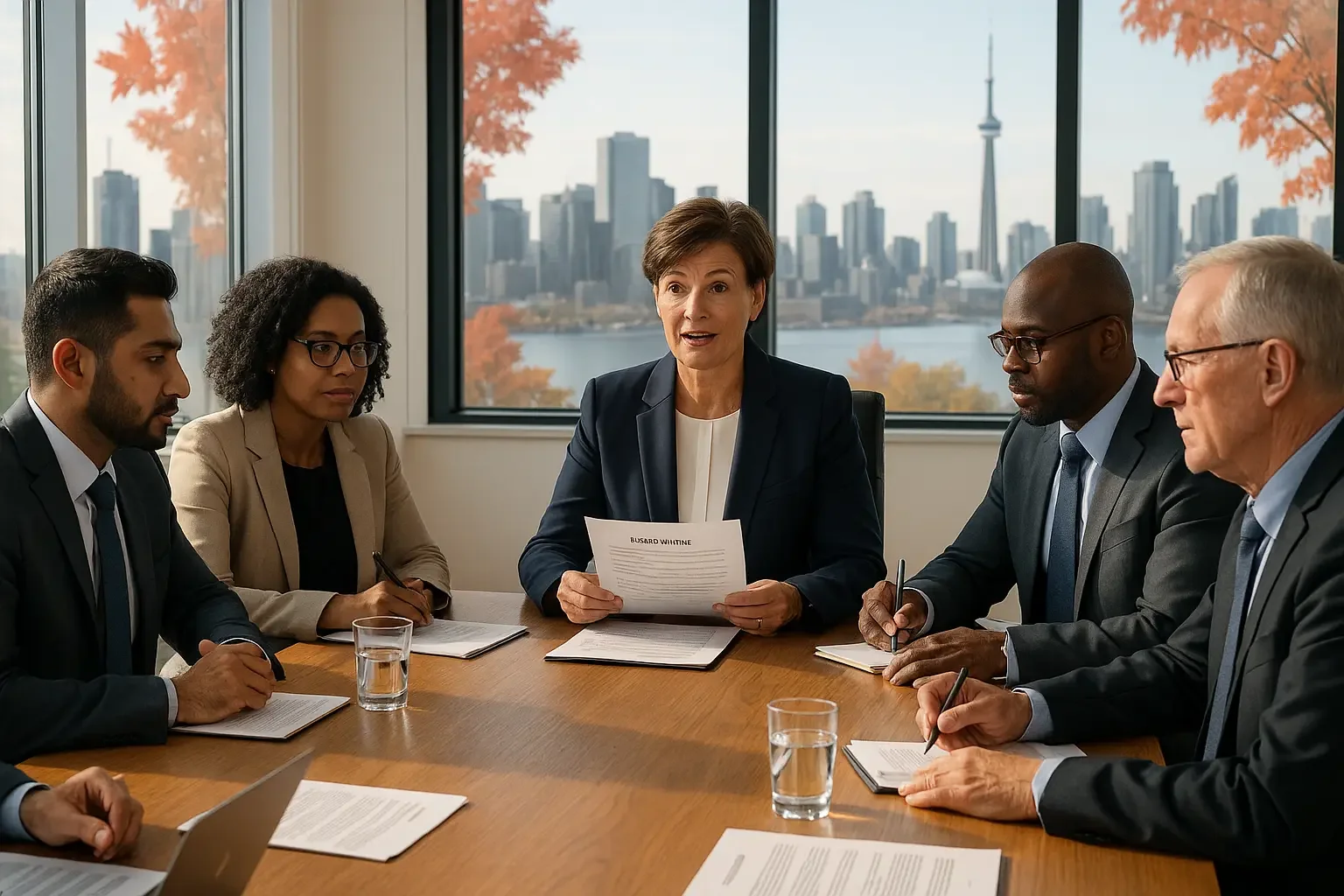
To chair a board meeting in Canada, you lead the process, not the outcome. You confirm quorum, follow your bylaws and governing statute (such as the Canada Not-for-profit Corporations Act or Ontario's Not-for-Profit Corporations Act, 2010), manage conflicts of interest, guide each agenda item to a clear decision, and make sure that decision is accurately recorded in the minutes.
A good chair stays neutral during debate, draws out every director's view, and keeps the board focused on governance rather than day-to-day operations.
Quick answer: how to chair a board meeting in 7 steps
Prepare the agenda with the secretary and executive director, labelling each item for decision, discussion, or information.
Send the board package early enough for directors to read it, and in line with any notice period in your bylaws.
Call the meeting to order and confirm quorum.
Ask for conflict-of-interest declarations and record them in the minutes.
Approve the agenda and previous minutes.
Guide each item through motion, discussion, and vote, restating every motion before the vote.
Adjourn, then follow up. Review the draft minutes and track action items until they're done.
The rest of this guide explains each step, the Canadian legal rules behind them, and what to say at each stage.
What Does a Board Chair Do in Canada?
A board chair (also called the chairperson or president, depending on your bylaws) is the director responsible for leading meetings of the board and making sure the board does its governance job. The chair has no more legal authority than any other director outside of meetings, unless the bylaws or a board resolution give it to them.
The chair's role has three parts:
Meeting leader. Runs the meeting fairly, follows the agenda, and applies the rules of order.
Board leader. Keeps the board focused on strategy, oversight, and risk. Supports director development and board evaluation.
Link to management. Acts as the main point of contact with the executive director or CEO. The chair supports and holds management to account, but does not manage the organization day to day.
Chair vs. executive director: the board, led by the chair, governs. The executive director manages. When the chair starts directing staff or making operational decisions alone, governance breaks down. For a full comparison, see Chairman of the Board vs CEO in Canada.
The Legal Rules Every Canadian Chair Must Know
Most of how a meeting runs comes from three sources, in this order of priority:
The governing statute. This is the CNCA for federal not-for-profits, the ONCA for Ontario, or the relevant provincial act (for example, B.C.'s Societies Act).
Your articles and bylaws.
Your adopted rules of order and board policies, such as Robert's Rules of Order, Bourinot's Rules, Wainberg's Society Meetings, or, in Quebec, the Code Morin.
When the bylaws are silent, the statute's default rule usually applies. Check these six areas before every meeting.
| Topic | What the chair must know |
|---|---|
| Quorum | Under the CNCA and ONCA, unless your bylaws set a different number, quorum is generally a majority of directors. ONCA bylaws can't set it below two-fifths. Without quorum, the board can't make valid decisions. |
| Conflicts of interest | Directors must disclose the nature and extent of a material interest in a contract or transaction (CNCA s. 141; ONCA s. 41). The disclosure goes in writing or in the minutes. A conflicted director generally doesn't vote on the matter. |
| Virtual & hybrid meetings | Ontario's 2023 ONCA amendments allow fully electronic or hybrid director meetings unless the bylaws say otherwise. Everyone must be able to communicate simultaneously and instantaneously. Federal and other provincial rules differ, so check your statute and bylaws. |
| Written resolutions | Both statutes allow the board to act without a meeting through a resolution signed by all directors entitled to vote. It has the same effect as one passed at a meeting. |
| Casting vote | Neither statute automatically gives the chair a tie-breaking vote. Your bylaws decide. If they're silent, a tied motion fails. |
| Minutes & records | Minutes are a legal record. They support CRA reviews, audits, and any dispute. Charities should keep them with their other books and records. |
Learn more: Quorum for Board Meetings in Canada · What Is a Board Meeting in Canada?
Essential Responsibilities of the Chairperson
The chairperson has key duties that ensure board meetings run smoothly and effectively. These include directing the board's strategic focus, managing discussions, coordinating with the secretary on logistics, and maintaining clear communication with all stakeholders.
Guiding the Board's Work
Your job is to keep the board at the governance level, on strategy, oversight, risk, and accountability, and out of operations. Set meeting priorities with the executive director. Make sure big decisions get enough time. Make sure each director understands an issue before being asked to vote on it.
Staying Neutral and Fostering Discussion
Lead the process, not the opinion. Strong chairs open a topic with a question, not their own view. They invite quieter directors in by name and calmly limit anyone who dominates.
Useful prompts to improve a discussion:
"What are we missing?"
"What would make this decision fail?"
"What options haven't we considered?"
"How would our members, donors, or regulators view this decision?"
If you want to argue strongly for one side of a motion, consider handing the chair to the vice-chair for that item.
Working with the Secretary
Your secretary or governance lead is your closest operating partner. Together you:
Build the agenda and the board package
Confirm notice and quorum
Make sure minutes are accurate
Keep track of action items between meetings
Representing the Board
The chair usually speaks for the board, to management and, when authorized, to members, funders, regulators, and the media. Speak only to decisions the board has actually made, and protect confidential matters.
Preparing for a Board Meeting
Effective board meeting preparation involves careful agenda development, clear objectives, proper documentation, and confirmed attendance. These elements support productive discussions and informed decision-making.
Developing and Distributing the Agenda
We create a well-structured agenda to keep our board focused. The chairperson works with the secretary to develop this document. Our agenda lists all items for discussion in order of priority. We include time estimates for each topic to help manage the meeting flow.
Key agenda components include:
Approval of previous minutes
Committee reports
Old business items
New business proposals
Financial updates
We distribute the agenda at least four working days before the meeting. This gives board members time to prepare. The secretary attaches supporting documents to the agenda. These materials help members understand the topics. Board members can request agenda changes up to two days before the meeting. We submit these requests to the chairperson or secretary.
Establishing Meeting Objectives
We set clear objectives for every board meeting. These goals help us stay focused on what matters most. Our objectives align with the organization's strategic priorities. We focus on items that need board-level attention and decision-making.
Common board meeting objectives:
Review organizational performance
Approve major decisions
Provide oversight and governance
Address strategic issues
We communicate these objectives through the agenda structure. Each agenda item has a clear purpose and expected outcome. Committee meetings often support our board objectives. We review committee recommendations and reports during the main meeting. Time management becomes easier with specific goals. We allocate time to each agenda item based on its importance.
Ensuring Proper Documentation
We prepare all necessary documents before the meeting. Proper documentation supports informed decision-making and legal compliance. The secretary gathers and organizes meeting materials. We create a board package that includes all relevant documents.
Essential meeting documents include:
Previous meeting minutes
Financial statements
Committee reports
Background materials for new business
Correspondence requiring board attention
We distribute this board package with the agenda. Members need time to review materials before the meeting. All documents should be clearly labelled and organized. We use consistent formatting to make information easy to find. Digital distribution often works best for sharing documents. We ensure all board members can access materials in their preferred format.
Confirming Quorum and Attendance
We confirm that enough members will attend to achieve quorum. Without quorum, our board cannot make valid decisions. Our organization's bylaws specify the minimum number needed for quorum, often 51% of total board membership.
Steps to confirm attendance:
Send meeting notices well in advance
Follow up with members who haven't responded
Maintain an attendance tracking system
Have backup plans for key presenters
We contact absent members before the meeting when possible. This helps us know who will participate. The chairperson verifies quorum at the meeting's start. We do not proceed with official business without the required number of members present. Committee meetings also need proper attendance to function well. We track participation across all governance activities. Struggling with long board meetings? Learn how a consent agenda helps streamline discussions and keep your board focused.
Running the Meeting: Step-by-Step
Step 1: Call to Order and Confirm Quorum
Start on time. State the time, confirm quorum, and confirm the secretary is recording. See What Is a Call to Order in a Charity Board Meeting.
Step 2: Declarations of Conflict of Interest
Ask every director to declare any conflict. Record each declaration and how it was handled in the minutes: for example, whether the director left the room or abstained from the vote.
Step 3: Approve the Agenda
Ask for any additions, accept or decline them, and approve the agenda by motion.
Step 4: Approve the Previous Minutes
Ask for corrections and note them. Then approve the minutes as presented or as amended. See Board Meeting Minutes.
Step 5: Reports and Business
Ask presenters to highlight what needs a board decision, not read their written report aloud. Committee recommendations still need a board motion. The board doesn't adopt them automatically.
Step 6: In-Camera Session
Many Canadian boards end with an in-camera session, with directors only and staff absent. This keeps sensitive matters private and gives directors candid time together.
Step 7: Adjourn
Confirm action items, owners, and deadlines, then adjourn.
Chair's script: what to say
| Moment | What you can say |
|---|---|
| Opening | "I call this meeting to order at 6:02 p.m. We have seven of nine directors present, so we have quorum." |
| Conflicts | "Does anyone have a conflict of interest to declare on any item on today's agenda?" |
| Agenda | "Are there any changes to the agenda? … May I have a motion to approve the agenda as presented?" |
| Minutes | "Are there any corrections to the minutes of our September meeting?" |
| Motion | "We have a motion moved by Priya and seconded by Marc. The motion is: [read it word for word]. Is there any discussion?" |
| Moving on | "We've heard the main points. Unless there's something new, I'll call the vote." |
| Vote | "All in favour? Opposed? Abstentions? The motion is carried." |
| In camera | "We'll now move in camera. I'll ask staff and guests to leave the meeting." |
| Close | "There being no further business, this meeting is adjourned at 8:14 p.m." |
Facilitating Debate and Decision-Making
Motions
A director makes the motion, another director seconds it (if your rules require seconders), and the chair restates it word for word. Discussion then begins. Motions should be specific: say who will do what, by when, and at what cost. See How to Make a Motion at a Board Meeting.
Amendments
Deal with amendments before the main motion. Debate and vote on the amendment first, then return to the main motion as amended or unchanged.
Many boards use Robert's Rules, under which no one speaks a second time until everyone who wants to speak has spoken once. Apply whichever rules your board has actually adopted.
Ending Debate
Under Robert's Rules, a motion to "call the question" (formally, the previous question) needs a two-thirds vote. Smaller boards often reach the same result more informally, with the chair summarizing and asking whether directors are ready to vote.
Voting
Restate the motion before every vote.
Use a show of hands, a voice vote, or the voting tool on your video platform for virtual meetings.
Record abstentions. Record named dissents when a director asks. In some cases a director who wants to avoid liability for a decision must have their dissent recorded.
The chair's vote: in most small boards the chair is a voting director. Whether the chair also gets a casting vote to break a tie depends entirely on your bylaws.
See Nonprofit Board Voting Procedures in Canada.
Chairing Virtual and Hybrid Board Meetings
Virtual and hybrid meetings are now routine for Canadian boards. First check that your statute and bylaws allow them. Then:
Send joining instructions with the notice, including how to attend, speak, and vote. Ontario's ONCA now requires this for electronic meetings.
Test the technology before the meeting. Have a phone dial-in as a backup.
Confirm that everyone can hear and be heard. If a director drops off, quorum may be lost. Pause until they reconnect or quorum is restored.
Take each vote by roll call or with an on-screen poll, and record the result.
Run hybrid meetings fairly. Call on remote directors first so in-room voices don't take over.
For in-camera sessions, move staff to a waiting room or a separate link, and confirm that nobody else is present off-camera.
AI Note-Takers and Recording Tools
Many boards now use AI transcription or summary tools. Before allowing them, the chair should make sure the board has a policy that covers:
Consent: whether the meeting may be recorded or transcribed at all
In-camera and legal advice: recordings of in-camera discussion or legal advice can undermine confidentiality and solicitor-client privilege
Privacy: where the data is stored and who can access it
Records: the approved minutes, not an AI transcript, are the official record
When in doubt, turn AI tools off for in-camera items.
Special Board Meeting Considerations
In-Camera Sessions
Use in-camera sessions for personnel matters, executive director evaluation and pay, legal matters, and confidential negotiations. Announce the move in camera, ask non-directors to leave, and keep confidential minutes that record decisions, not detailed discussion. Announce the return to open session.
Business Arising and New Business
Deal with business arising from the last meeting first. Major new items should come with notice and supporting papers. Urgent additions need the board's agreement when the agenda is approved.
Committee Reports
Committee chairs present their recommendations, and each recommendation needs a board motion. Ask committees to submit written reports in advance so that meeting time is spent on decisions.
Need to postpone a meeting instead? Read How to Cancel a Board Meeting in a Canadian Charity.
How to Handle Difficult Situations as Chair
| Situation | What to do |
|---|---|
| One director dominates | Use the speaking order, set time limits, and invite others in by name. If it continues, have a private word after the meeting. |
| A director won't declare an obvious conflict | Raise it neutrally, refer to the conflict policy, and let the board decide. Record the outcome. |
| You (the chair) have a conflict | Declare it, and hand the chair to the vice-chair for that item. |
| Quorum is lost mid-meeting | Stop making decisions. Remaining items can be discussed but not decided, or deferred. |
| Debate turns personal | Call a short break, restate the issue, and remind directors to address the chair, not each other. |
| Papers arrive late on a big decision | Consider deferring the decision. Deciding without proper information is a governance risk. |
| Agreement comes too quickly | Ask "What would make this fail?" before calling the vote. |
Concluding and Following Up After the Meeting
Review the Minutes
Minutes record decisions, not every word. The chair should review the draft for accuracy, especially the exact wording of motions, conflict declarations, and dissents. Many boards aim to circulate draft minutes within a week. The minutes become official once the board approves them at the next meeting.
See this meeting minutes example from B.I.G. Charity Law Group.
Track Action Items
Every action needs four things:
Who owns it
What exactly must be done
When it is due
How progress will be reported
Review open actions under "business arising" at the next meeting.
Keep Records Safe
Store approved minutes, conflict declarations, and written resolutions securely with the organization's records. Registered charities must keep their books and records available for CRA review.
Evaluate and Improve
Ask directors for quick feedback after meetings, and run a full board self-evaluation each year. Use what you learn to adjust agenda length, the quality of papers, and meeting format.
Common Mistakes Board Chairs Make
Opening a discussion with their own opinion
Letting operational detail crowd out strategy
Skipping conflict-of-interest declarations
Taking votes without restating the motion
Treating silence as agreement
Assuming they have a casting vote without checking the bylaws
Approving committee recommendations without a board motion
Recording in-camera or legal discussions with AI tools
Not following up on action items
Board Chair Checklist
Before the meeting
[ ] Agenda labelled for decision, discussion, or information
[ ] Notice and board package sent according to the bylaws
[ ] Quorum confirmed
[ ] Likely conflicts identified
[ ] Technology tested (for virtual or hybrid meetings)
During the meeting
[ ] Called to order and quorum confirmed
[ ] Conflicts declared and recorded
[ ] Every motion restated before the vote
[ ] Every director invited to speak
[ ] Actions confirmed before adjournment
After the meeting
[ ] Draft minutes reviewed
[ ] Action items distributed
[ ] Records stored
[ ] Feedback gathered
Key Takeaways
The chair leads the process, not the outcome. Stay neutral and draw out every view.
Your statute and bylaws control quorum, conflicts, virtual meetings, and casting votes. Check them before you chair.
Use a labelled agenda, a consent agenda, and a clear script to keep meetings on time.
Record decisions, conflicts, and dissents accurately. The minutes are your legal record.
Follow-through between meetings is where good chairing pays off.
OrgHub helps Canadian not-for-profits stay organized and compliant, from incorporation to bylaws and ongoing board governance. Get started with OrgHub or explore Manage Your Nonprofit.
Frequently Asked Questions
How do you chair a board meeting for the first time?
Read your bylaws and the governing statute first. Meet with the secretary and executive director to build the agenda. Then follow a simple script: call the meeting to order, confirm quorum, ask for conflicts, approve the agenda and minutes, take each item through motion and vote, and adjourn. Consider asking an experienced director to act as an informal procedural advisor.
What are the five main responsibilities of a board chair?
Setting the agenda with management
Running the meeting fairly and on time
Making sure governance rules are followed, including quorum and conflicts
Guiding the board to clear decisions
Acting as the board's main link to the executive director
Does the board chair vote in Canada?
Usually yes. In most small boards the chair is a director with a regular vote. A second, tie-breaking "casting" vote exists only if your bylaws provide one.
What is quorum for a board meeting in Canada?
Under the CNCA and ONCA, quorum is generally a majority of directors unless the bylaws set a different number. Ontario bylaws can't set it below two-fifths of the board. Always check your own bylaws.
Can a Canadian board meeting be held virtually?
In most cases, yes. Ontario's ONCA allows virtual or hybrid director meetings unless the bylaws say otherwise, as long as everyone can communicate at the same time. Federal and other provincial rules vary, so check your statute and bylaws.
What does the chair say to start a meeting?
"I call this meeting to order at [time]. We have [number] directors present, so we have quorum. Does anyone have a conflict of interest to declare?"
What should a chair not do?
Don't push your own view during debate, skip conflict declarations, let one director dominate, call a vote on an unclear motion, or treat silence as agreement.
Do I need to use Robert's Rules of Order?
Only if your bylaws or board policy adopt them. Many Canadian boards use Robert's, Bourinot's, or Wainberg's rules, and many Quebec boards use the Code Morin. Smaller boards often use simplified rules.
Who chairs if the chair is absent or conflicted?
Usually the vice-chair. If there's no vice-chair, the directors present typically choose someone to chair that meeting or that item, as the bylaws allow.
What are the most useful phrases for chairing a meeting?
"I call this meeting to order."
"Do we have quorum?"
"Does anyone have a conflict to declare?"
"Are there any corrections to the minutes?"
"The floor is open for discussion."
"Let's hear from anyone who hasn't spoken yet."
"The motion on the floor is…"
"All in favour? Opposed? Abstentions?"
"We'll now move in camera."
"This meeting is adjourned."