
What Happens If Your Nonprofit Misses Its Annual Return in Canada?
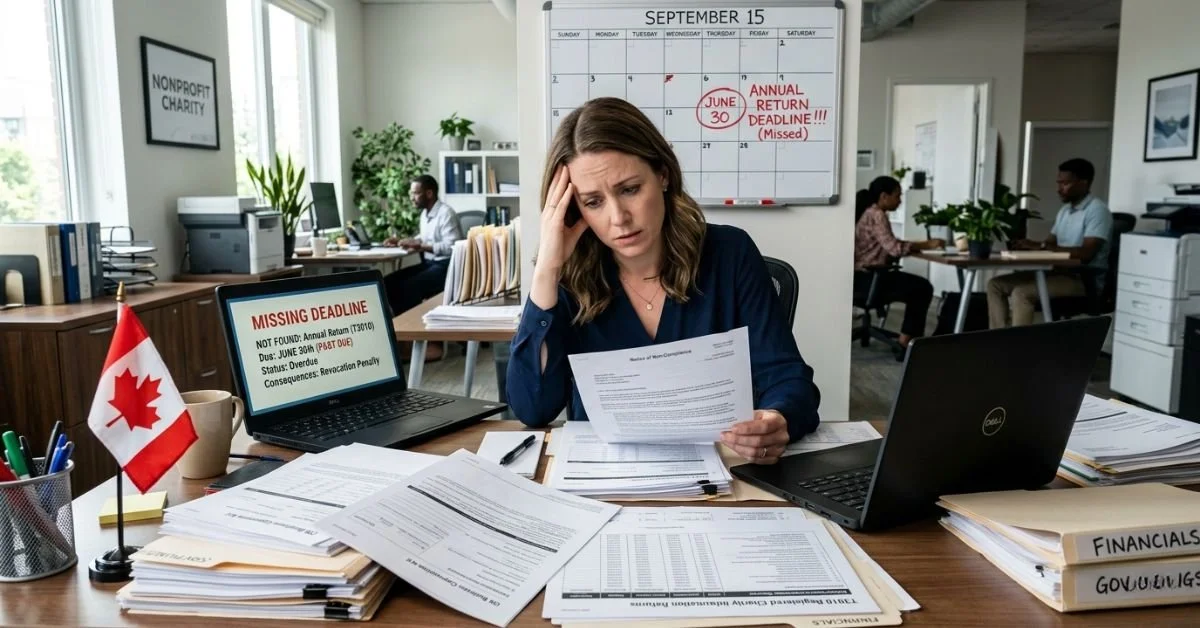
Missing an annual return is a serious compliance issue for not-for-profit corporations in Canada. Organizations that fail to meet their filing obligations can face consequences from Corporations Canada and the Canada Revenue Agency.
These consequences include financial penalties and possible loss of legal status. If a not-for-profit corporation misses its annual return with Corporations Canada for three consecutive years, it faces automatic dissolution.
Registered charities that fail to file their T3010 information return with the Canada Revenue Agency risk revocation of their charitable status. Both requirements are critical for maintaining legal standing and tax-exempt status.
Understanding the steps after a missed filing helps boards and directors act quickly. Some organizations can be revived or reinstated, but this process involves specific steps and timelines.
This article explains the requirements, consequences, and options available to not-for-profit corporations and registered charities that have fallen behind on their annual reporting obligations.
Regulatory Framework: The "Two-Master" Rule
In Canada, a federally incorporated registered charity must answer to two distinct masters: Corporations Canada (which governs corporate existence) and the Canada Revenue Agency (which governs tax status). Missing a filing with one authority does not excuse a missed filing with the other. Both sets of obligations run independently and concurrently.
| Requirement | Governing Authority | Due Date | Consequence of Failure |
|---|---|---|---|
| Annual Return (Form 4022) | Corporations Canada (CNCA) | Within 60 days of Anniversary Date | Administrative Dissolution |
| T3010 (Charities) | CRA — Charities Directorate | Within 6 months of Fiscal Year-End | Revocation of Charitable Status |
| T1044 (NPOs) | CRA | Within 6 months of Fiscal Year-End | Penalties (up to $2,500/year) |
| T2 (Income Tax) | CRA | Within 6 months of Fiscal Year-End | Loss of tax-exempt status |
Understanding which authority governs which obligation — and the specific deadlines attached to each — is the foundation of nonprofit compliance in Canada.
Core Filing Requirements for Not-for-Profit Corporations
Federal not-for-profit corporations in Canada have two main filing obligations. They must file a corporate annual return with Corporations Canada and tax filings with the Canada Revenue Agency.
The annual return must be filed within 60 days of the corporation's anniversary date each year. This deadline applies to both regular NPOs and registered charities.
Annual Return Versus Tax Return
The annual return filed with Corporations Canada is required under the Canada Not-for-Profit Corporations Act (CNCA). This filing is separate from tax returns or registered charity information returns submitted to the Canada Revenue Agency.
The annual return updates basic corporate information in the public database. It includes the date of the last annual meeting of members and identifies whether the corporation is soliciting or non-soliciting.
A corporation is considered soliciting if it receives more than $10,000 in income from public sources in a financial year. Tax filings serve a different purpose.
Registered charities must file T3010 forms. Other not-for-profit corporations may need to file T1044 forms depending on their activities and income.
Who Must File: NPOs and Registered Charities
Every federal not-for-profit corporation with an "active" legal status must file an annual return. This applies regardless of the organization's size, activity level, or charitable registration status.
Registered charities incorporated under the CNCA must file both their annual return with Corporations Canada and their charitable information returns with the CRA. These are two separate obligations.
Corporations that are not currently active still must file if their legal status remains active. The only exception is for corporations that have been dissolved, discontinued, or amalgamated with another organization.
Key Filing Deadlines and the Anniversary Date
The anniversary date is when the corporation was incorporated, amalgamated, or continued under the NFP Act. This date is on the Certificate of Incorporation, Amalgamation, or Continuance and can be found through the Corporations Canada online database.
Corporations must file their annual return within 60 days after the anniversary date. The return must reflect the corporation's situation on that specific anniversary date each year.
Early filing before the anniversary date is not allowed. Corporations Canada sends an annual return reminder by email to subscribers or by post to the registered office address.
Organizations can file through the Online Filing Centre. A director, officer, or authorized individual with knowledge of the corporation must complete the submission.
Legal Consequences of Missing an Annual Return
Missing an annual return can threaten a nonprofit's existence. Legal consequences include administrative dissolution, loss of charitable status, and compliance restrictions.
Administrative Dissolution and Loss of Legal Status
Corporations Canada may dissolve a nonprofit that fails to file annual returns. The law allows dissolution after one year of non-filing, but the current policy dissolves corporations after three consecutive years of missed filings.
The dissolution process includes multiple warning stages. When a nonprofit misses its filing deadline, its status shows as "overdue" in the Corporations Canada online database.
About 90 days after the anniversary date, Corporations Canada sends a default notice. Before dissolution, the organization receives a final notice with an additional 120 days to file all overdue returns.
Administrative dissolution legally ends a corporation's existence. The nonprofit loses its legal capacity to conduct activities, enter contracts, or hold property.
The organization's name appears in the Corporations Canada Monthly Transactions publication before dissolution occurs. A dissolved nonprofit can no longer operate legally in Canada.
All corporate powers end, and ongoing activities may lack legal protection or authority.
Loss of the Corporate Veil: Once a corporation is dissolved, it ceases to exist as a legal entity. Directors who continue to take actions on behalf of the dissolved corporation — signing contracts, accepting funds, or conducting programs — may inadvertently assume personal liability for those acts. There is no corporate shield to protect them once dissolution has occurred.
Property Escheat: Under common law and the CNCA, the property of a dissolved corporation can technically escheat to the Crown. While the government rarely moves to seize assets immediately, dissolution creates a significant title cloud over any real estate, bank accounts, or other assets held by the entity. This can complicate future revival efforts and expose the organization's assets to claims.
Revocation of Charitable Status
Registered charities face additional risks beyond corporate dissolution. The Canada Revenue Agency (CRA) requires charities to file a T3010 annual information return.
If a nonprofit corporation is dissolved by Corporations Canada while holding registered charity status, this can lead to the revocation of charitable status under the Income Tax Act. The CRA starts the process of revoking a charity's registration in the tenth month after the charity fails to file its T3010 return.
The CRA starts the process of revoking a charity's registration in the tenth month after the charity fails to file its T3010 return.
Loss of charitable status means the charity cannot issue tax receipts for donations. This severely impacts fundraising and public trust.
Penalties, Fees, and Compliance Restrictions
Nonprofits with overdue annual returns face immediate operational restrictions. The organization cannot obtain a certificate of compliance from Corporations Canada while filings are overdue.
A certificate of compliance proves that a corporation has met all filing requirements. Banks, funders, and government agencies often require this document for various transactions.
Without it, nonprofits cannot access certain grants, open bank accounts, or complete legal transactions. The annual return filing fee is $12 per year when filed online.
Late filings still require payment of this fee for each overdue year. Organizations must file all missing returns and pay all fees before regaining good standing.
Missing annual return reminders does not excuse the filing requirement. Nonprofits remain legally obligated to file regardless of whether they receive notifications.
Tax Compliance and Information Return Obligations
Canadian nonprofits have specific tax filing requirements even when exempt from income tax. The Canada Revenue Agency requires different forms based on an organization's structure and financial thresholds.
CRA Compliance for NPOs and Charities
Registered charities must file a T3010 Registered Charity Information Return annually. This requirement applies to all registered charities.
Nonprofits described in paragraph 149(1)(l) of the Income Tax Act face different rules. An NPO must file Form T1044 if it meets any of these conditions:
Received taxable dividends, interest, rentals, or royalties exceeding $10,000 in the fiscal period
Held total assets worth more than $200,000 at the end of the previous fiscal period
Filed a T1044 in any previous year
Once an organization files a T1044, it must continue filing for all future fiscal periods. This applies even if revenues drop below $10,000 or assets fall below $200,000.
The Canada Revenue Agency requires organizations to keep books and records for six years from the end of the last tax year. Organizations must keep documentation of assets and liabilities, including long-term investments.
Forms T2, T3010, and T1044 Overview
The T2 Corporation Income Tax Return applies to incorporated nonprofits. Most NPO corporations must file a T2 even when claiming tax-exempt status under section 149(1)(l).
The T3010 requires charities to report financial information, including total revenues, expenditures, and program activities. Charities must also disclose whether they conduct activities outside Canada.
Form T1044 requires nonprofits to complete seven parts:
Identification and fiscal period details
Amounts received during the fiscal period
Statement of assets and liabilities
Remuneration paid to officers and employees
Description of organizational activities
Location of books and records
Certification by an authorized signing officer
Some organizations operating dining, recreational, or sporting facilities must file a T3 Trust Income Tax and Information Return. These entities are treated as deemed trusts under the Income Tax Act.
Implications Under the Income Tax Act
Section 149(1)(l) grants tax exemption to clubs, societies, or associations organized for social welfare, civic improvement, pleasure, recreation, or any purpose except profit. This exemption requires that no income be payable to members for personal benefit.
Organizations lose their tax-exempt status if they fail to meet Income Tax Act requirements. The CRA can reassess past years and impose taxes on previously exempt income.
Late filing of the T1044 triggers a penalty of $25 per day, with a minimum of $100 and maximum of $2,500 per return. The Canada Revenue Agency may waive penalties only when extraordinary circumstances beyond the organization's control caused the delay.
Organizations must file returns within six months after their fiscal period ends. Missing this deadline creates immediate compliance issues and potential penalties.
A public accountant's report is not required with the NPO Information Return. Maintaining proper books and records remains mandatory.
Impact on Governance and Operations
Missing annual returns creates immediate obstacles for how a not-for-profit corporation manages its internal processes. The corporation faces barriers to making official changes and maintaining transparency with members and the public.
Effect on Annual Meetings and Membership
Not-for-profit corporations must report the date of their last annual meeting of members on each annual return. When a corporation falls behind on filing, this creates a disconnect between what members approve at meetings and what appears in public records.
Members rely on up-to-date information from Corporations Canada to verify who serves as directors and where the registered office is located. Organizations that skip filing become marked as "overdue" in the Corporations Canada online database.
This public status signals to members, donors, and partners that the corporation may not be managing its legal obligations properly. The gap between actual operations and official records grows with each missed filing.
Financial Disclosure and Audit Requirements
Soliciting corporations face specific and legally significant complications when they miss annual returns. Under the CNCA, a corporation becomes "Soliciting" if it receives more than $10,000 in public funds — including donations from non-members, government grants, or funds from another soliciting entity — in a single financial year. Once a corporation crosses this threshold, it retains Soliciting status for the next three years, regardless of subsequent revenue levels.
The compliance consequences of Soliciting status are substantial:
Financial Disclosure: Soliciting corporations must file financial statements with Corporations Canada, which are made available to the public. When a soliciting corporation fails to file, stakeholders cannot access current financial information, which directly undermines donor confidence and may affect future funding relationships.
Public Accountant Requirement: A Soliciting corporation must appoint a public accountant and may be required to undergo a full audit. An audit can only be avoided if specific "review engagement" or "dispensing" resolutions are passed — and in certain cases, these resolutions require unanimous member consent. Missing filings while subject to these obligations compounds the organization's legal exposure significantly.
Restrictions on Amending Articles and Bylaws
A corporation behind on its annual returns cannot proceed with filing articles of amendment until it catches up on all overdue returns. This prevents the organization from making official changes to its name, director numbers, membership classes, or purpose statement.
Corporations Canada requires current standing before accepting any amendments. If members vote to change the articles at an annual meeting, the corporation must file all missing annual returns first, then submit the articles of amendment.
The same rule applies to registering new bylaws or bylaw amendments, which organizations must file within 12 months of member confirmation.
Dissolution, Revival, and Future Compliance Strategies
If a nonprofit continues to miss its annual returns, Corporations Canada may dissolve the organization. Revival is possible through a formal application process.
Organizations can avoid these problems by setting up systems to track deadlines and respond to reminder notices.
How Administrative Dissolution Proceeds
Corporations Canada can dissolve a nonprofit after three years of failing to file annual returns. The organization receives multiple reminder notices before dissolution occurs.
These notices go to the registered office address on file. When Corporations Canada dissolves a nonprofit, it issues a Certificate of Dissolution.
The corporation stops being a legal entity at that point. It cannot conduct business, enter contracts, or hold property.
The dissolution happens without court involvement. Corporations Canada sends a final notice before taking this step.
Organizations that ignore these warnings lose their legal status and all the benefits that come with incorporation.
Reviving a Dissolved Corporation
If your corporation has been dissolved, revival is governed by Section 219 of the CNCA. Any interested person may apply — this includes former directors, officers, members, employees, creditors, or anyone with a contractual relationship with the organization.
The revival application requires:
Form 4015 — Articles of Revival, filed together with all overdue annual returns
A NUANS Real-Time System name search report — required if the corporation has been dissolved for more than two years, to confirm the name has not been claimed by another entity during the dissolution period
The required filing fee
Corporations Canada may impose conditions on the Certificate of Revival. The organization typically must file at least two outstanding annual returns within 120 days of revival. Failure to meet those conditions can result in immediate re-dissolution.
On Retroactivity: Once a Certificate of Revival is issued, the corporation is generally deemed to have never been dissolved — a legal fiction that restores most of its prior standing. However, this retroactivity does not automatically resolve third-party contractual disputes or liability claims that arose during the dissolution period. Organizations should seek legal advice on any obligations that accrued while the corporation was dissolved.
The corporation number stays the same. The anniversary date remains the original incorporation date, not the revival date.
Annual Return Reminder Notices and Best Practices
Corporations Canada sends annual return reminder notices to the registered office address before each deadline. Organizations have 60 days after their anniversary date to file.
The Online Filing Centre provides digital access to submit returns and update information. Groups like the B.I.G. Charity Law Group recommend maintaining accurate books and records year-round to simplify annual filing.
Nonprofits should maintain a compliance calendar that tracks the anniversary date and filing deadline. Designating a staff or board member to monitor these dates prevents missed filings.
Organizations should also keep their registered office address current to ensure they receive all reminder notices from Corporations Canada.
CRA Consequences: Revocation and the Path to Re-Registration
For registered charities, missing the T3010 is among the most serious compliance failures possible. The revocation process unfolds in stages, each with significant legal consequences.
Notice of Intention to Revoke: If a charity fails to file its T3010 within six months of its fiscal year-end, the CRA will issue a formal Notice of Intention to Revoke. This notice is not merely administrative — it triggers a legal process that ends in the permanent loss of charitable status if not addressed.
Revocation Tax: Upon revocation, a charity may become liable for a 100% Revocation Tax on the value of all remaining assets. The only way to avoid this tax is to transfer those assets to an "eligible donee" — defined as another registered charity that deals at arm's length with the revoked organization and is in good standing with the CRA. This transfer must be completed before revocation takes legal effect.
Re-Registration Is Not Automatic: Once charitable status is revoked, organizations cannot simply resume operations. They must apply for re-registration through the CRA's My Business Account portal, pay a $500 penalty, and affirmatively demonstrate that they continue to meet all substantive requirements for charitable status under the Income Tax Act. The CRA reviews each application on its merits — prior registration does not guarantee reinstatement.
Compliance Checklist: Maintaining Good Standing Year-Round
To maintain Good Standing, the Board of Directors must ensure the following at all times:
☐ Anniversary Date Monitoring: Identify the anniversary date on your Certificate of Incorporation. Set a recurring calendar alert at least 30 days before the filing deadline to allow adequate preparation time.
☐ Registered Office Address Maintenance: Ensure the Registered Office Address on file with Corporations Canada is current and actively monitored. If Corporations Canada sends a notice to an outdated address and the organization claims it did not receive it, this is not a valid legal defence. The obligation to maintain an accurate address rests entirely with the corporation.
☐ Director Updates: File Form 4006 within 15 days of any change to the board of directors. Do not wait for the Annual Return to report director changes — the CNCA imposes a standalone obligation to report these promptly.
☐ Fiscal Year Coordination: Ensure your T3010, T1044, and T2 filings are aligned with your fiscal year-end, which may differ from your corporate anniversary date. Both deadlines must be tracked independently to avoid inadvertently missing a CRA obligation while staying current with Corporations Canada.
Expert Resources and Support for Nonprofits
Nonprofits facing filing challenges can access professional advisors and government tools to maintain compliance. The Canada Revenue Agency and Corporations Canada provide free resources, while specialized firms offer personalized guidance for complex situations.
Professional Guidance and Advisory Firms
Nonprofit organizations often benefit from working with professionals who understand Canadian charity law. Law firms like B.I.G. Charity Law Group specialize in nonprofit compliance and can help organizations navigate CNCA requirements.
These firms assist with filing issues, governance questions, and regulatory concerns. Accounting professionals familiar with nonprofit tax rules can prepare T3010 returns and ensure financial reporting meets CRA standards.
They review financial statements and recommend corrective actions before problems arise. Legal advisors help nonprofits understand their obligations under federal and provincial laws.
Some organizations hire consultants who focus solely on nonprofit management and compliance. These experts provide training for board members and develop internal policies.
Professional support costs money, but it often prevents expensive penalties or dissolution proceedings.
Official CRA and Corporations Canada Tools
The Canada Revenue Agency offers T4117, the Income Tax Guide to the Non-Profit Organization Information Return. This free guide helps nonprofits understand what information they must report and when submissions are due.
Corporations Canada operates the Online Filing Centre, where nonprofits submit annual returns and access their corporate records. The system costs $12 per filing and provides immediate confirmation when submissions are complete.
Organizations can search the federal corporation database to check their filing status and upcoming deadlines. Both agencies publish guides, fact sheets, and frequently asked questions on their websites.
The CRA provides telephone support for T3010 questions, while Corporations Canada answers queries about annual returns and corporate obligations.
Maintaining Good Standing Year After Year
Nonprofits should create internal calendars that track all filing deadlines, including the 60-day window after their anniversary date for Corporations Canada submissions. Setting reminders three months before deadlines allows time to gather required information and resolve any issues.
Organizations can subscribe to annual return reminder notices from Corporations Canada to receive automatic notifications. Regular board meetings should include compliance updates to keep directors informed of upcoming obligations.
Maintaining organized records throughout the year makes filing season less stressful and reduces the risk of missing deadlines.
Conclusion
Missing your nonprofit's annual return in Canada can create serious problems. After three years of non-filing, Corporations Canada will dissolve your nonprofit, which means it loses its legal status and can no longer operate.
Even before dissolution, nonprofits that miss deadlines face immediate consequences like an "overdue" status in the public database and the inability to obtain certificates of compliance.
The good news is that staying compliant doesn't have to be complicated. Organizations need to file within 60 days of their anniversary date each year.
Corporations Canada sends reminder notices to help nonprofits stay on track, but it's still the organization's responsibility to meet the deadline.
OrgHub makes annual return filing simple and stress-free. Organizations canget started for free to manage their compliance requirements in one place.
Whether you need help filing your annual return, tracking important deadlines, orstarting your nonprofit, OrgHub provides the tools you need.Contact us today to learn how we can help keep your organization in good standing with Corporations Canada.
Frequently Asked Questions
Missing an annual return leads to penalties, potential dissolution, and operational challenges that Canadian nonprofits need to address quickly.
What penalties or consequences can a Canadian nonprofit face for filing its annual return late?
Late filing of annual returns can result in serious consequences for Canadian nonprofits. Organizations incorporated under the Canada Not-for-Profit Corporations Act face potential dissolution if they fail to file for multiple years.
Corporations Canada can legally dissolve a nonprofit after one year of non-filing, though their policy typically allows three years before taking action.
Registered charities face additional penalties from the Canada Revenue Agency. The CRA can revoke charitable status if a T3010 Annual Information Return is not filed within six months of the fiscal year-end.
Late filing may also result in financial penalties that accumulate over time. The nonprofit loses its good standing status with Corporations Canada.
This affects the organization's ability to conduct legal activities and maintain credibility with stakeholders.
How long can a nonprofit delay its annual return before it risks losing its status with the CRA?
Registered charities must file the T3010 Annual Information Return within six months of their fiscal year-end. Missing this deadline puts charitable registration at immediate risk.
The CRA has the authority to revoke charitable status after the filing deadline passes. For federal nonprofits under the Canada Not-for-Profit Corporations Act, Form 4022 must be filed within 60 days of the corporation's anniversary date each year.
While Corporations Canada's policy allows up to three years of non-filing before dissolution, the organization is technically in default after missing just one annual return.
After three years of non-filing, Corporations Canada sends a final notice by mail to all directors at their registered addresses. The corporation receives an additional 120 days to file all outstanding returns before dissolution occurs.
What steps should a nonprofit take immediately after realising it missed the annual return deadline?
The organization should file the overdue annual return as quickly as possible through the Corporations Canada Online Filing Centre. All outstanding returns must be submitted to bring the nonprofit into compliance.
Directors should verify that all corporate information is current and accurate before filing. This includes confirming the registered office address, current director information, and the date of the last annual meeting of members.
The nonprofit should review any notices received from Corporations Canada or the CRA. These communications often contain specific instructions and deadlines that must be followed to avoid dissolution or status revocation.
Organizations should also assess whether other compliance requirements were missed. This includes filing changes to director information, registered office address updates, or financial statements if the nonprofit is a soliciting corporation.
Can a nonprofit request an extension or relief from late-filing consequences in Canada, and how?
Corporations Canada does not offer formal extensions for annual return deadlines. The 60-day filing period following the anniversary date is fixed under the Canada Not-for-Profit Corporations Act.
Nonprofits that receive a final dissolution notice get an automatic 120-day grace period to file outstanding returns. This is the only standard extension available in the process.
The CRA may consider relief requests for registered charities on a case-by-case basis. Organizations must contact the CRA directly to discuss their specific situation and any extenuating circumstances.
Documentation supporting the request strengthens the case for relief. Nonprofits that have been dissolved can apply for revival.
This process allows organizations to restore their corporate status after dissolution has occurred, though it requires filing all outstanding returns and paying applicable fees.
How does missing an annual return affect a nonprofit's ability to fundraise, access grants, or maintain public trust?
Nonprofits that fall out of good standing cannot legally conduct business activities. This directly impacts their ability to enter into contracts, open bank accounts, or engage in standard operations necessary for fundraising.
Grant-making organizations and foundations typically require proof of good standing before releasing funds. Missing annual returns means the nonprofit cannot obtain certificates of compliance or status from Corporations Canada, which are often mandatory grant application documents.
Public trust erodes when a nonprofit fails to meet basic compliance requirements. Donors and stakeholders can access corporate information through the Corporations Canada website, and missing filings signal poor governance and management.
Registered charities that lose their charitable status lose the ability to issue tax receipts. This eliminates a major incentive for individual donors and can devastate fundraising capacity.
What records and information are typically needed to complete a past-due annual return for a Canadian nonprofit?
The annual return requires the corporation's anniversary date. It also needs information current as of that date.
This includes a complete list of directors with their full names and residential addresses. Organizations must provide the registered office address as it was on the anniversary date.
Any changes made after that date should be filed separately as change notifications. The date of the last annual meeting of members must be included on the form.
If the nonprofit used a written resolution instead of a meeting, the date when all eligible members signed the resolution serves as the meeting date. Soliciting nonprofits need additional documentation.
These organizations must file financial statements and any public accountant reports for each missed year. The financial documents must reflect the organization's position at the relevant fiscal year-end.
Contact information for at least one director who can respond to questions about the filing is required. This ensures Corporations Canada can reach someone if issues arise during processing.